
Jan 06, 2026 · 7 min read
Methodology notes
SCADA and Unified Namespace (UNS): Architectural Roles in Modern IIoT
Technical comparison of SCADA-centric and Unified Namespace architectures for modern industrial data distribution.
- Evidence level: Medium (field observations + public standards; not a universal benchmark).
- Measurement scope: Performance and economic outcomes vary by hardware, topology, workload shape, sampling profile, and process constraints.
- Primary references: IEC 62443, ISA-95 / IEC 62264, NIST SP 800-82r3.
- Implementation docs: Edge Architecture and Unified Namespace.
Supervisory Control and Data Acquisition (SCADA) has been a central component of factory visibility and operations for decades.
Today, many teams are reevaluating SCADA's role in broader enterprise data architectures.
This shift is not about removing HMIs or process control. It is about whether SCADA should remain the central routing hub for all enterprise data flows.
In cloud-connected environments with analytics and multi-system integration, routing all traffic through a SCADA-centric topology can increase integration cost and change-management overhead. For this reason, that role is increasingly complemented or replaced by Unified Namespace (UNS) patterns.
| Capability | Traditional SCADA | Unified Namespace |
|---|---|---|
| Data Access | Poll-based (ask every N seconds) | Pub/Sub (instant push on change) |
| Scaling Cost | Per-tag licensing (upgrade costs) | High topic capacity (flat license) |
| Integration | Point-to-point (N×M connections) | Hub-and-spoke (single broker) |
| Context | Raw tag values only | Rich ISA-95 metadata |
| Cloud Ready | Requires middleware gateways | Native MQTT + TLS |
Results vary with workload, hardware, and topology.
The Monolithic Trap: Why SCADA Became a Blockade
In a classical automation architecture (the ISA-95 model), SCADA sits directly above the PLC layer. Historically, if any upper-level software-say, an MES, a historian, or an ERP system-needed data from a machine on the floor, it was forced to ask the SCADA system for it.
SCADA often became the primary mediation layer for factory data access. This created recurring integration and cost challenges for many manufacturers:
Vendor Lock-In and Scalability Constraints
Because the SCADA software routes all data, scaling often requires upgrading to higher tag-based licensing tiers. Want to connect ten new vibration sensors to feed a predictive AI model? That will push you into the next license tier. In some deployments, this results in substantial upgrade costs.
Data Mapping Operational Burden
When you connect an ERP to a SCADA system point-to-point, you are creating a fragile, custom-coded pipeline. If a PLC engineer changes a tag name from Pump_Spd_01 to PMP01_Speed, the SCADA mapping breaks, the ERP integration crashes, and the daily production report goes blank.
Context Destruction
SCADA was built for human operators staring at screens, not for cloud algorithms. It strips away the deep engineering context of the data. To the SCADA screen, a value is just "65 degrees." To an enterprise AI, it needs to know that this is specifically "Celsius, originating from Zone 2 of the Paint Bake Oven, on Line B, during active production of SKU #9012."
The Paradigm Shift: The Unified Namespace (UNS)
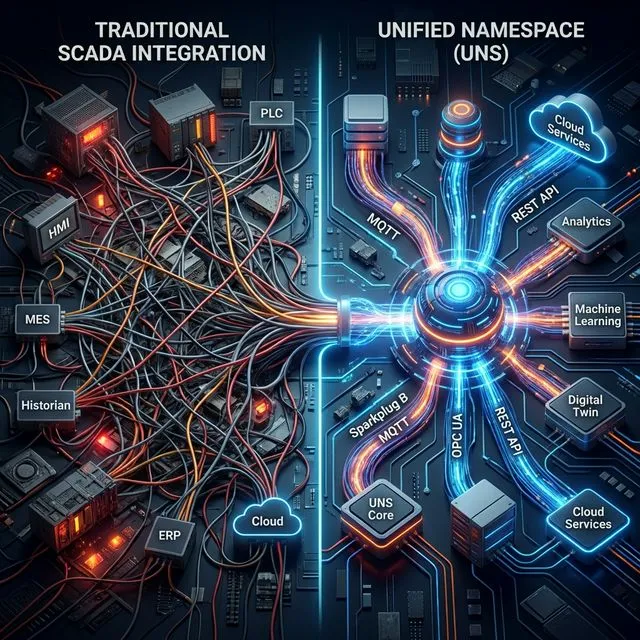
A limitation of traditional SCADA architectures is their routing bottleneck. They capture the data and act as the sole distributor for external systems.
The Unified Namespace (UNS) can move SCADA away from the architectural center in many deployments. Instead of stacking systems on top of each other, the UNS places a high-speed, event-driven data hub (typically an MQTT Broker) at the geographical center of the IT/OT network.
Every single participant in the factory now connects independently to the UNS.
- The PLCs and Edge Gateways publish raw machine states directly to the UNS.
- The ERP publishes the daily production schedule to the UNS.
- The AI Analytics engine subscribes to the UNS to listen for vibration anomalies.
- And the SCADA system? Its role shifts from central broker to one consumer among many. It simply becomes just another subscriber/consumer of the UNS data, tasked purely with drawing graphics on a screen.
Why UNS Changes Data Distribution Patterns
The Unified Namespace unlocks three critical operational advantages that SCADA architectures cannot match.
Limitless Scalability
When you decouple the data producer from the data consumer, operational decoupling improves maintainability. If you want to add a brand-new cloud analytics platform tomorrow, you do not touch the PLCs. You do not touch the SCADA system. You simply point the new cloud software at the UNS and say, "Subscribe to the Factory Data." It takes minutes, not months.
The Single Source of Truth
In a UNS architecture, there is no debate about whether the MES database or the SCADA historian has the "right" data. The current state of the entire business exists identically in one place, updated in milliseconds. It serves as a shared source of truth for connected consumers.
Mitigating Licensing Overheads
Because data flows through an open-standard MQTT Unified Namespace, you can scale data collection independently of SCADA tag limits. You can stream 50,000 tags from the factory floor to your enterprise data lake without necessarily triggering a SCADA licensing upgrade.
SCADA Tag Limits Impact ROI: Traditional SCADA systems charge licensing fees per data point (typically by tag blocks, vendor and contract dependent). A 10,000-tag factory expansion could trigger six-figure new licensing costs in some pricing models. UNS on MQTT can reduce this bottleneck by decoupling downstream consumers from SCADA tag-count growth.
Proxus: The Engine of the Unified Namespace
Transitioning away from a SCADA-centric architecture sounds daunting, but it does not require a rip-and-replace of your physical factory.
The Proxus Platform was engineered specifically to facilitate this transition. Our Edge Gateways connect to your existing, legacy PLCs, bypass the proprietary SCADA bottlenecks, and publish your machine data directly into a strictly formatted, ultra-fast MQTT Unified Namespace.
Modern manufacturing cannot run at the speed of human polling. SCADA isn't going away - we still need operators to push buttons and watch tanks fill - but its reign as the primary aggregation layer for industrial data is over.
When this may not be suitable
- Lower-frequency telemetry may not justify full distributed complexity.
- Small single-line plants may prefer simpler architectures first.
- Strict legacy constraints may require phased adoption.
- Safety-critical closed-loop control should remain in PLC/Safety PLC layers.
Observed performance depends on workload shape, node capacity, and deployment design.
Frequently Asked Questions
Should I replace my existing SCADA immediately?
No. SCADA continues to serve its core purpose: operator visualization and manual control of specific processes. Historically reduced is SCADA's role as the exclusive gateway to machine data. In a UNS architecture, SCADA becomes one of many consumers subscribing to the namespace - not the gatekeeper.
How does UNS compare to SCADA historian for data storage?
SCADA historians store compressed time-series data accessible via proprietary APIs with vendor-specific tag naming. A UNS-backed data lake stores the same data in open formats with semantic context, accessible by any consumer. The critical difference: UNS data is already contextualized (e.g., Plant/Line1/OEE), while historian data requires manual mapping to extract meaning.
Can I run SCADA and UNS in parallel during migration?
Yes, and this is the recommended approach. During Phase 3 of UNS rollout, SCADA systems are gradually reconfigured to subscribe to the UNS instead of polling PLCs directly. This eliminates the "big bang" risk and allows incremental validation.
References
- ISA-95 / IEC 62264 - The automation hierarchy standard that both SCADA and UNS architectures reference, albeit with different topologies.
- MQTT v5.0 OASIS Standard - The publish-subscribe protocol that replaces SCADA's polling-based data acquisition model. mqtt.org
- Eclipse Sparkplug - The MQTT payload standard that adds the semantic data modeling SCADA historians provide, without the vendor lock-in. sparkplug.eclipse.org