
Connect Machines, PLCs, and
Industrial Systems
Onboard PLCs, SCADA, meters, sensors, and supported protocols into one governed operational data layer. Model source-specific signals once, then reuse them across dashboards, storage, MES, ERP, analytics, and approved AI consumers.
Why Connectivity with Proxus?
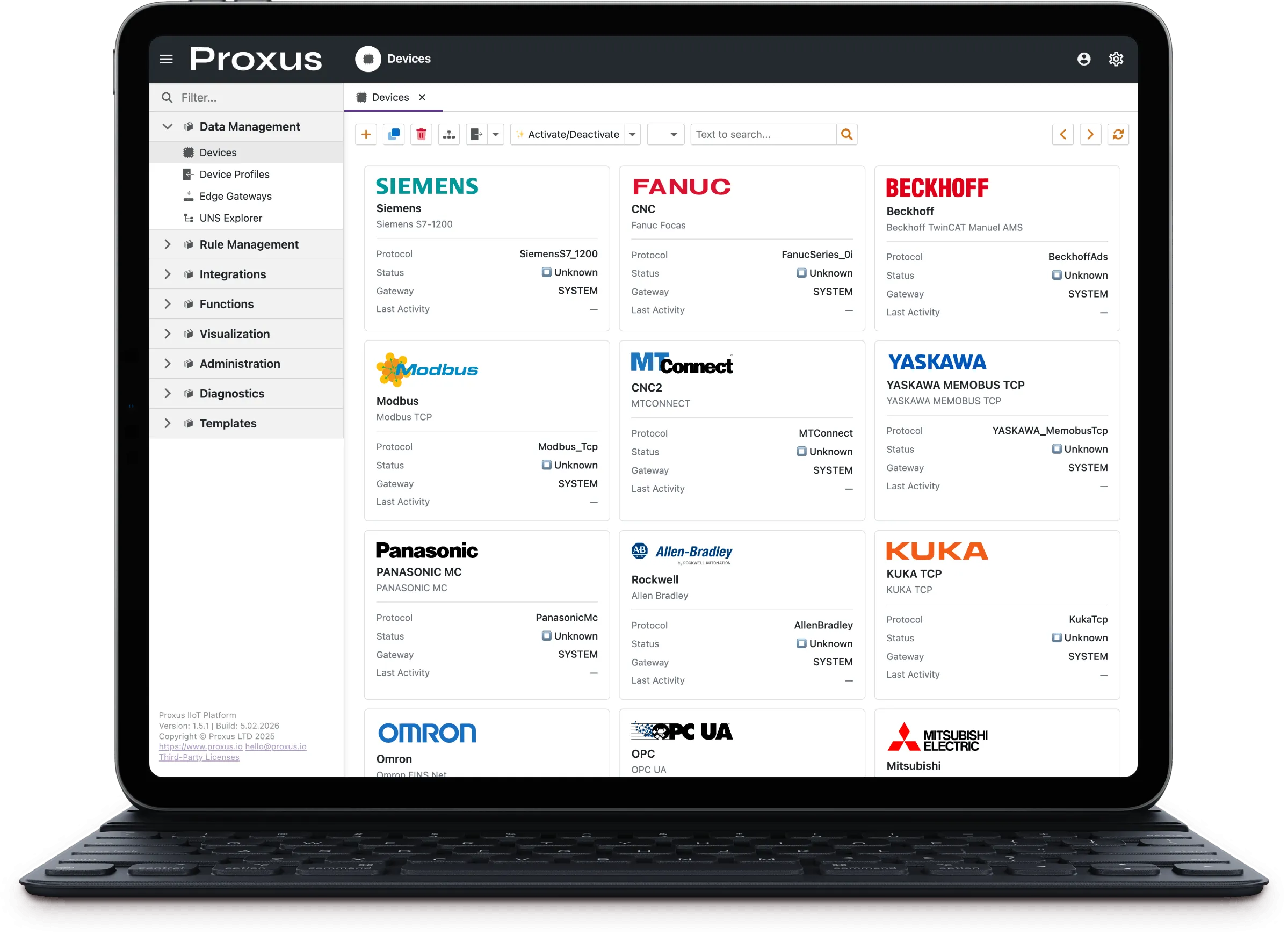
Every plant already runs a mix of PLCs, SCADA, historians, and IT systems. Proxus provides a governed connection surface for supported sources so downstream integrations can reuse normalized operational data. See how it fits the platform.
- Supported industrial connections include S7, Modbus, OPC UA, MQTT, Ethernet/IP, ADS, and edition-specific drivers documented by Proxus.
- Shared operational model through governed UNS topic mapping and owned tag dictionaries.
- Central configuration, edge execution, reuse validated templates across compatible gateways.
- Edition-aware licensing, validate protocol availability, gateways, and data capacity through the current regional quote.
How it fits the Proxus Platform
Connectivity lives at the edge, but configuration and observability are centralized. You onboard devices once, map tags to the UNS model, and Proxus keeps the contracts stable across all plants. Review use cases or the protocol library.
Collect from PLCs, meters, sensors on site. Buffers and normalizes close to the machine with reliable delivery.
Publishes normalized tags into the unified namespace so every consumer (dashboards, AI, analytics) reads from one source.
Fan out governed UNS topics to approved cloud or on-premises targets without coupling every consumer to source-specific addresses.
Connection Flow
Select a template (e.g., S7, OPC UA, Modbus) and enter endpoint details.
Apply a tag map to align with your UNS naming (enterprise/site/area/line).
Deploy to selected gateways; buffering and normalization run locally at the edge.
Route normalized tags to UNS topics and selected integration targets.
Track connection state, last message time, and drop counts centrally.
Works online or offline; when links drop, events are buffered and replayed in order. No reconfiguration per site, reuse the same template across lines, plants, and countries.
Use Cases
Reuse validated connection templates across compatible brownfield and greenfield deployments while keeping site-specific addresses, credentials, and topology explicit. Dive into the FAQ for rollout details.
Brownfield retrofit
Wrap legacy PLCs with UNS topics and push data to modern dashboards and AI without touching the control logic.
Energy & utilities
Collect Modbus meters, publish to UNS, and forward to analytics or carbon accounting tools.
SCADA + ERP bridge
Expose production counters and downtimes via UNS topics and share with MES/ERP or data lakes without custom drivers each time.
Multi-site standardization
Reuse a validated connectivity template across compatible plants while keeping the tag taxonomy and site-specific configuration controlled.
Security, Governance, and Reliability
Connectivity only matters if it is safe and predictable. Proxus applies the same guardrails everywhere, edge, UNS, and integrations.
- Least-privilege access per connection profile and topic namespace.
- Isolation at the edge, no inbound ports to PLCs; traffic is outbound and brokered.
- Store-and-forward for flaky links; data replays in order when the line is back.
- Health metrics for each connector: connection state, drop counts, last message time.
Standard Outputs
- UNS topics for real-time distribution
- Normalized tag names and engineering units
- Change detection to reduce chatter
- Optional buffering for offline sites
- Outbound routing to cloud/on-prem targets
FAQ
Common questions on licenses, performance, and scaling your connectivity footprint.
Protocol availability and licensing depend on the selected edition, version, gateways, and data capacity. Review the current scope through regional pricing.
Templates can be reused across compatible gateways and sites after validating device addresses, protocol settings, credentials, topology, and version constraints.
Configured connectors can buffer and recover data when connectivity returns; the result depends on buffer capacity, outage duration, traffic, and acknowledgement behavior.
Update behavior must be sized against protocol polling, tag volume, network conditions, change detection, edge workload, and target-system acknowledgement.
Technical and Commercial Evaluation
Industrial Connectivity evaluation guide
Operational problem it addresses
OT and IT teams need a repeatable way to acquire source-specific signals without rebuilding every downstream integration around device addresses and protocol details.
Data sources it connects
- PLCs and remote I/O
- SCADA and OPC UA servers
- Meters, sensors, and gateways
- MQTT brokers and supported industrial endpoints
How the data is processed
- 1.Connect each source with an edition- and version-supported driver.
- 2.Validate values and map source paths into governed operational names.
- 3.Buffer according to the selected edge capacity and connector behavior.
- 4.Deliver the normalized stream to UNS, storage, dashboards, and approved outbound consumers.
Edge and outage behavior
Buffering and recovery depend on available capacity, outage duration, traffic, polling, and connector acknowledgement behavior. Validate these limits against the target topology before rollout.
Systems that consume the data
- Unified Namespace
- Dashboards
- Industrial historian
- MES and ERP
- Analytics and BI
- Approved AI consumers
Security and deployment boundary
Deploy in customer-controlled infrastructure, scope credentials per source, and use governed outbound delivery patterns. Required inbound access and certificate behavior depend on the selected protocol and topology.
Technical validation and next step
When it is a good fit
- You need to normalize multiple OT sources for several consumers.
- You are standardizing repeatable connectivity across compatible sites.
- You need edge-local acquisition with explicitly sized recovery behavior.
When it is not a good fit
- You only need a temporary one-off point connection.
- The required device, protocol, or version is not in the validated support scope.
- The project has no owner for naming, credentials, or operational context.
Evaluation FAQ
Which industrial protocols can I connect?
Support depends on the selected edition and version. Confirm the current driver and device scope in the protocol documentation and during architecture review.
What happens during a network interruption?
Configured connectors can buffer and recover data within the limits of capacity, outage duration, traffic, polling, and acknowledgement behavior.
Can I reuse a connectivity template across sites?
Yes, for compatible deployments after validating addresses, credentials, protocol settings, topology, and version-specific differences.
Build a governed connection layer for your OT sources
Start with the source, protocol, and topology blocking your next data consumer, then map a rollout path that OT and IT can operate together.