
IT/OT Integration for Enterprise Data Flow
Move plant-floor data into ERP, MES, Kafka, cloud platforms, analytics, and AI workflows without fragile point-to-point integrations. Proxus uses secure, outbound-only industrial data pipelines built around a governed UNS model.
Why bridge IT and OT with Proxus?
Plants need OT reliability and IT scale. Proxus routes shop-floor data to enterprise systems through a unified namespace and secure, outbound-only pipelines, no fragile point-to-point scripts. Use it as the OT data export layer when MES, ERP, BI, data lake, or AI teams need governed production context. See use cases in action.
- Single data plane via UNS, OT signals become standard topics that IT systems can safely consume.
- Outbound by default, no inbound PLC exposure; traffic flows out through secured gateways.
- Normalized tags so SAP, Kafka, and cloud analytics see consistent structures across sites.
- Governed access, topic-level permissions and read-only paths for critical production data.
Who uses it?
- Operations: production counters, downtime reasons into ERP/CMMS
- IT/Data: streams to Kafka, warehouses, data lakes
- Finance: energy and material usage for cost models
- Quality: SPC metrics and alarms into MES/analytics
- Leadership: rollups for multi-site visibility
Architecture Flow
OT / Shop Floor
PLCs, SCADA, Sensors
Secure Gateway
Outbound Only
IT / Enterprise
SAP, ERP, Kafka, Cloud
How it works
OT data is normalized and published to the unified namespace. Proxus then routes it outbound to enterprise targets, no inbound IT reach into the control layer. The same pipeline can feed an industrial data platform, OEE views, ERP/MES exports, and analytics systems. Dive into the integration docs for patterns.
- Collect from PLCs/SCADA and map tags to UNS topics.
- Normalize units and naming for cross-site consistency.
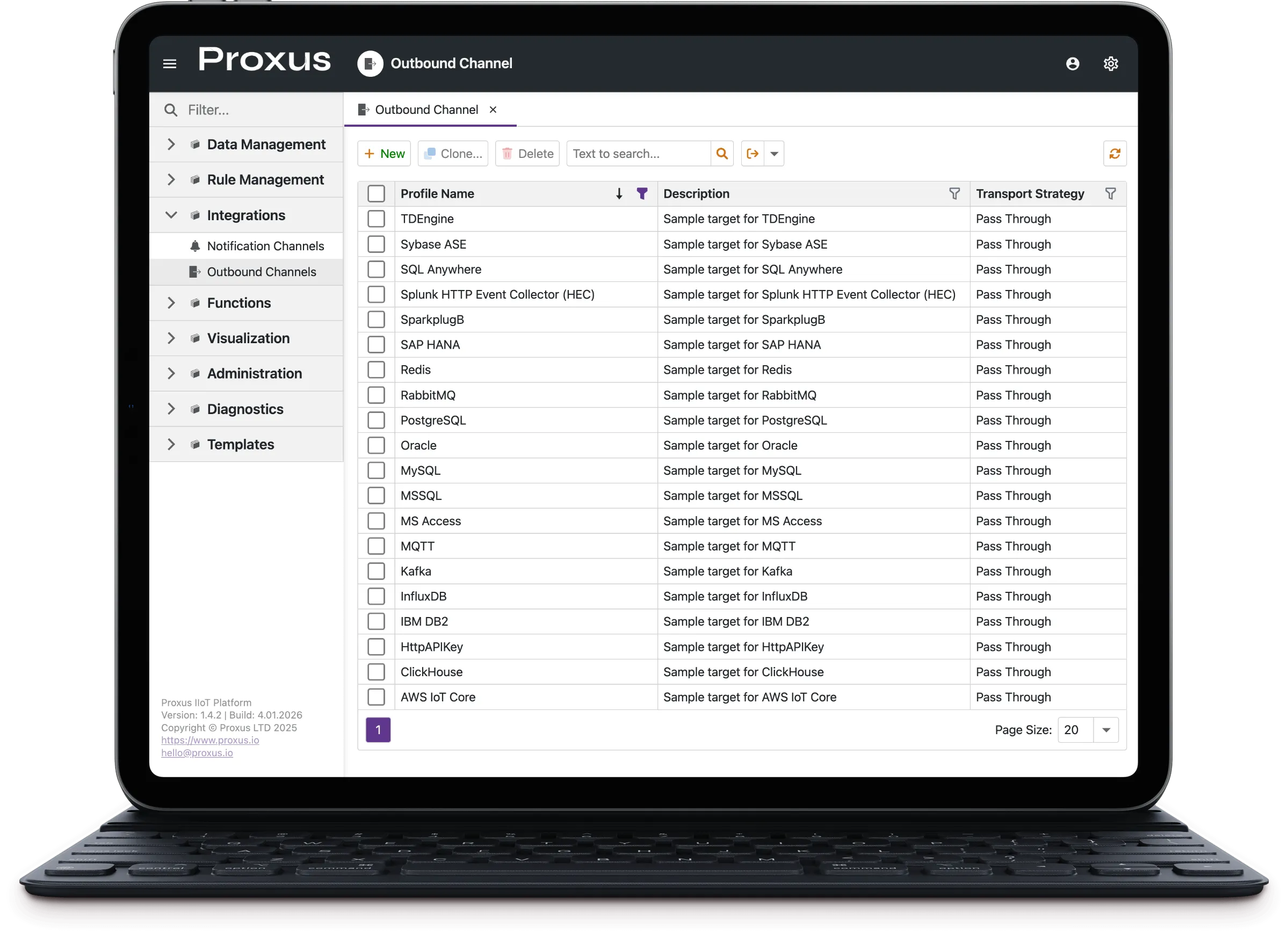
- Push outbound to Kafka, ERP, cloud, or HTTP targets.
- Optionally buffer at the edge; replay in order after outages.
- Audit and monitor connection health and throughput.
Outbound Targets
- ERP/MES (SAP, Dynamics, custom HTTP)
- Streaming (Kafka, MQTT brokers)
- Cloud (AWS, Azure, GCP services)
- Datastores (time-series, SQL/NoSQL, lakes)
- Analytics/AI platforms
Use Cases
Connect brownfield plants to enterprise apps without rewriting PLC logic or opening inbound ports. Review the FAQ for rollout details.
Maintenance & CMMS
Send downtime reasons and counters to ERP/CMMS for work orders automatically.
Data lakes & analytics
Stream normalized tags to Kafka or cloud lakes for AI, BI, and forecasting.
Energy & sustainability
Expose metering data to finance and ESG tools without touching control networks.
Quality & traceability
Publish SPC metrics and alarms to MES and analytics for faster root cause analysis.
Security and governance
Proxus treats OT data as critical. Traffic leaves the plant over controlled channels, and consumers only see what you expose.
- Outbound-only, no inbound paths to PLCs or SCADA.
- Topic-level authorization, share only required UNS topics with IT.
- Store-and-forward, data replays in order after network issues.
- Health monitoring, connection state, drop counts, last message times.
What IT sees
- Normalized topics with units and context
- Change-detected streams to reduce noise
- Optional buffering indicators
- Clear ownership per site/line for governance
FAQ
Common questions on security, latency, and enterprise rollout.
No. Traffic is outbound-only; PLCs are not exposed.
UNS mapping and normalized tags keep naming and units consistent everywhere.
Store-and-forward buffers at the edge and replays in order after outages.
Yes. Proxus collects and models OT data first, then routes governed streams to ERP, MES, BI, cloud, storage, and AI consumers.
Yes. Share only selected topics; keep control tags isolated and read-only.
Ready to converge IT and OT without risking the plant?
Expose only the data you need, keep control logic isolated, and feed ERP, Kafka, or cloud analytics from the same UNS.
Technical and Commercial Evaluation
IT/OT Integration Platform evaluation guide
Operational problem it addresses
Direct enterprise connections to PLCs, SCADA servers, and site databases create fragile dependencies and unclear ownership. The bridge provides a governed integration boundary where OT controls source access and context while IT receives stable, authorized data contracts.
Data sources it connects
- PLC, SCADA, OPC UA, MQTT, historian, and supported site data
- Production, asset, quality, maintenance, and energy context
- Enterprise reference data needed for governed correlation
How the data is processed
- 1.Collect source data inside the approved OT zone.
- 2.Normalize identity, units, timestamps, quality, and operational context.
- 3.Apply authorization, routing, transformation, and retention policies.
- 4.Deliver approved contracts to enterprise targets through monitored connectors.
Edge and outage behavior
Source, bridge, network, and target failures must be observed separately. Connectors can retry or buffer according to their configured behavior, but delivery depends on capacity, acknowledgements, idempotency, target health, and recovery procedures.
Systems that consume the data
- ERP
- MES
- CMMS
- BI
- Data lake
- Cloud
- APIs
- AI services
Security and deployment boundary
The bridge should minimize inbound paths into OT. Identities, certificates, secrets, topic or endpoint authorization, data classification, audit, remote administration, and writeback must be governed separately. Safety and control authority remain in OT control systems.
Technical validation and next step
When it is a good fit
- Several enterprise consumers need consistent OT contracts.
- OT and IT ownership boundaries must be explicit and auditable.
- Connectors, transformations, and delivery health require shared governance.
When it is not a good fit
- An enterprise application is expected to connect directly to machine control without an OT-owned boundary.
- The project treats data export as proof that command writeback is safe.
- Target idempotency, retries, and failure ownership cannot be defined.
Evaluation FAQ
Does IT/OT integration require inbound access from IT to PLC networks?
Not necessarily. Many telemetry and event flows can use OT-owned collection and controlled outbound delivery. Any inbound command path requires separate authorization, validation, audit, timeout, and safety design.
How are schema changes managed?
Treat source and target models as versioned contracts. Validate changes in a representative environment, identify affected consumers, provide compatibility or migration rules, and monitor rollout.
What makes an export reliable?
Reliability is an end-to-end property involving source capture, buffering, connector retries, acknowledgements, idempotency, target health, monitoring, and recovery. No single queue or protocol guarantees the whole path.