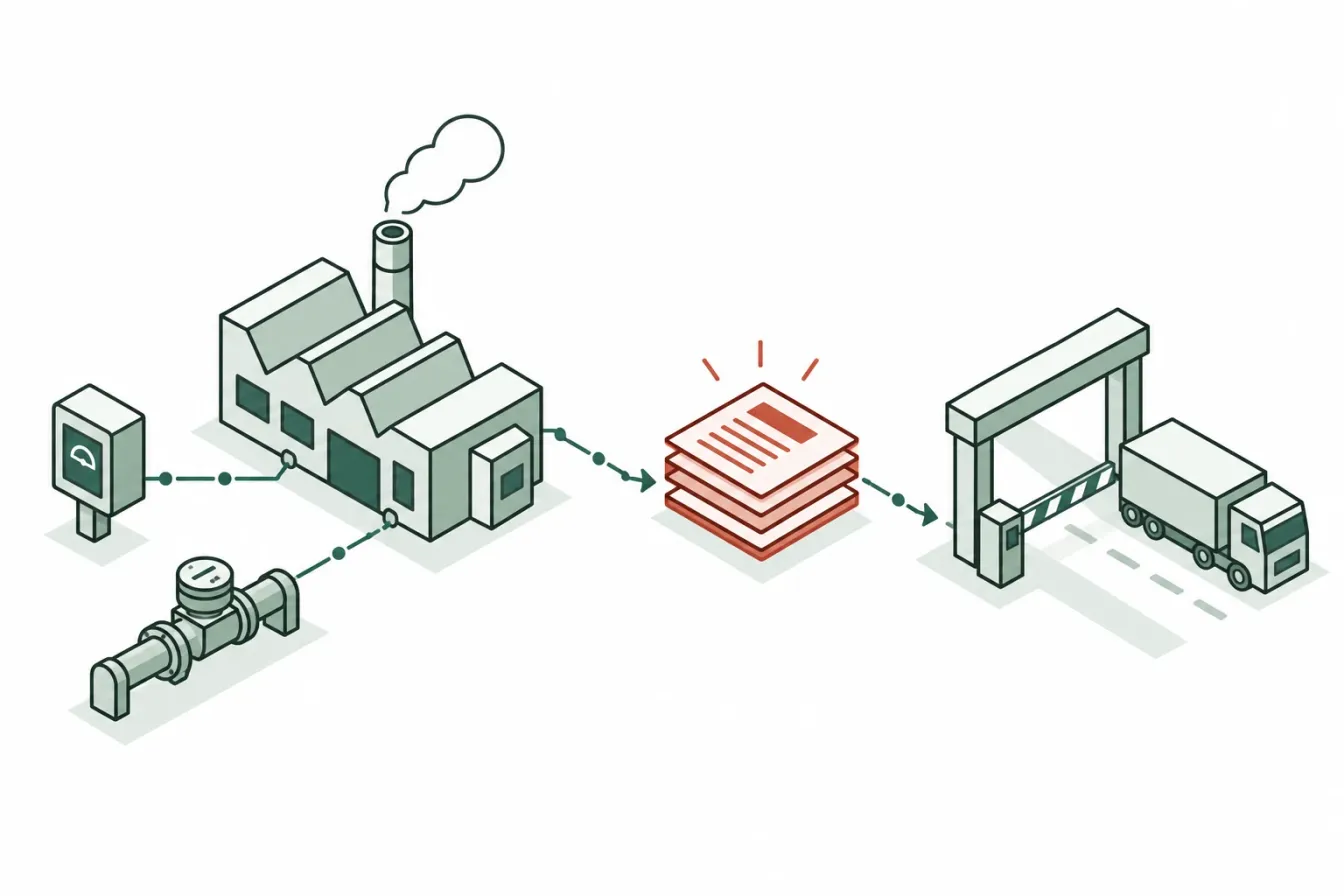
For many manufacturers, sustainability reporting used to sit outside daily production operations. CBAM changes that. Once emissions reporting affects customs cost, supplier selection, and audit readiness, plant data quality becomes part of export readiness.
If your factory produces goods in CBAM scope and exports them to the European Union, you typically need a more defensible way to trace embedded emissions than monthly spreadsheet estimates. The practical challenge is not only calculating emissions, but proving how the numbers were derived.
This guide explains the regulation at a working level, the data burden behind direct and indirect emissions, and how an industrial data architecture can support more auditable reporting. It is not legal or customs advice; product scope, importer obligations, calculation rules, and deadlines should be checked against the current European Commission guidance.
- 1 Jan 2026: CBAM financial phase begins
- Oct 2023: Transitional reporting phase began
Results vary with workload, hardware, and topology.
What is CBAM? (The Carbon Tariff Explained)
The EU created the Emissions Trading System (ETS) to price carbon emissions within its own borders. A related policy concern was "carbon leakage": production shifting to jurisdictions with lower carbon costs and then re-entering the EU market through imports.
CBAM is the EU's policy response. It is a border adjustment mechanism intended to align imported goods more closely with the carbon-cost logic already applied inside the EU.
If a Turkish aluminium plant supplies covered billets to an EU importer, the producer may need to provide installation and emissions data so the importer can meet its CBAM obligations. The legal responsibility, applicable threshold, calculation method, verification requirement, and certificate liability depend on the goods, origin, importer status, reporting year, and current EU rules.
If your non-EU factory is highly energy-efficient (running on renewables), your CBAM burden can be lower, and your product may remain more competitive. If your factory relies on high-carbon grids and inefficient ovens-and you cannot prove otherwise with verifiable data-your European client can face a materially higher tax bill, which may reduce order volume or shift sourcing decisions.
The Calculation operational burden: Direct vs. Indirect Emissions
The core data task is calculating and documenting embedded emissions under the methods applicable to the covered goods. Direct and, where the rules require them, indirect emissions must be handled according to the current CBAM methodology:
Direct Emissions (Scope 1)
These are emissions generated physically on your factory floor during the production process.
- Examples: Burning natural gas in heavy industrial furnaces to smelt aluminum, or chemical reactions that release CO2 during cement clinker production.
- The Challenge: You typically should sub-meter the exact amount of gas burned per specific production batch, not just look at the monthly facility utility bill.
Indirect Emissions (Scope 2)
These are the emissions generated by the power plant that supplied your factory's electricity.
- Example: The carbon footprint of the 5 Megawatts of electricity you pulled from the national grid to run your heavy extruders.
- The Challenge: You need a dynamic grid emission factor. Calculating how much electricity went exclusively into "Batch A of Export Steel" versus "Batch B of Domestic Steel" requires highly synchronized machine-state tracking.
Relying on generic averages long term is risky. If you rely on default values because your in-house data is insufficient, your declared emissions may be conservatively priced relative to measured plant reality. To reduce this risk, you typically should provide actual, metered data with auditable traceability.
Why Spreadsheets Are a high operational risk for CBAM
Most factories handed their initial CBAM reporting duties to a mid-level sustainability engineer armed with a massive Microsoft Excel workbook. This is a recipe for audit failure.
- Weak allocation evidence: Dividing a monthly utility invoice by total output may not preserve the installation, process, precursor, production-route, and product context required by the applicable calculation method.
- Missing Context: A spreadsheet does not know if a machine was running efficiently or if it spent 40 hours in a degraded, high-energy/low-output fault state.
- Audit Trails: When a European auditor asks for the definitive proof of the energy consumed by "Furnace 3 on October 14th between 08:00 and 12:00," finding a reliable paper trail in an Excel sheet is often impractical.
Structuring CBAM data with an industrial data platform
Factories that need product-level traceability typically should move beyond invoice-based estimation toward metered, time-aligned energy tracking. In practice, that overlaps heavily with the data discipline required for an ISO 50001 Energy Baseline.
With the Proxus Industrial Data Platform, teams can connect metering and production sources, add product and process context, retain evidence, and deliver approved data to the reporting workflow. Proxus supports the data pipeline; it does not determine legal scope or certify CBAM compliance.
Step 1: Sub-Meter the Production Assets
Proxus Edge Gateways can connect supported power analysers and flow meters through configured industrial protocols such as Modbus TCP, OPC UA or SNMP. Sampling frequency should be selected for the meter, process, reporting method, and infrastructure capacity.
Step 2: Contextualize Energy with Production Data
Proxus can combine authorised production state from PLC or MES sources with energy readings. A governed Unified Namespace model can associate readings with asset, process state, work order, and product context when those identifiers and mappings are available.
Step 3: Real-Time Carbon Calculation
A configured pipeline or C# function can apply approved emission factors to measured consumption. Factor source, validity period, version, calculation boundary, and approval should be retained with the result.
Step 4: Audit-Ready Exports
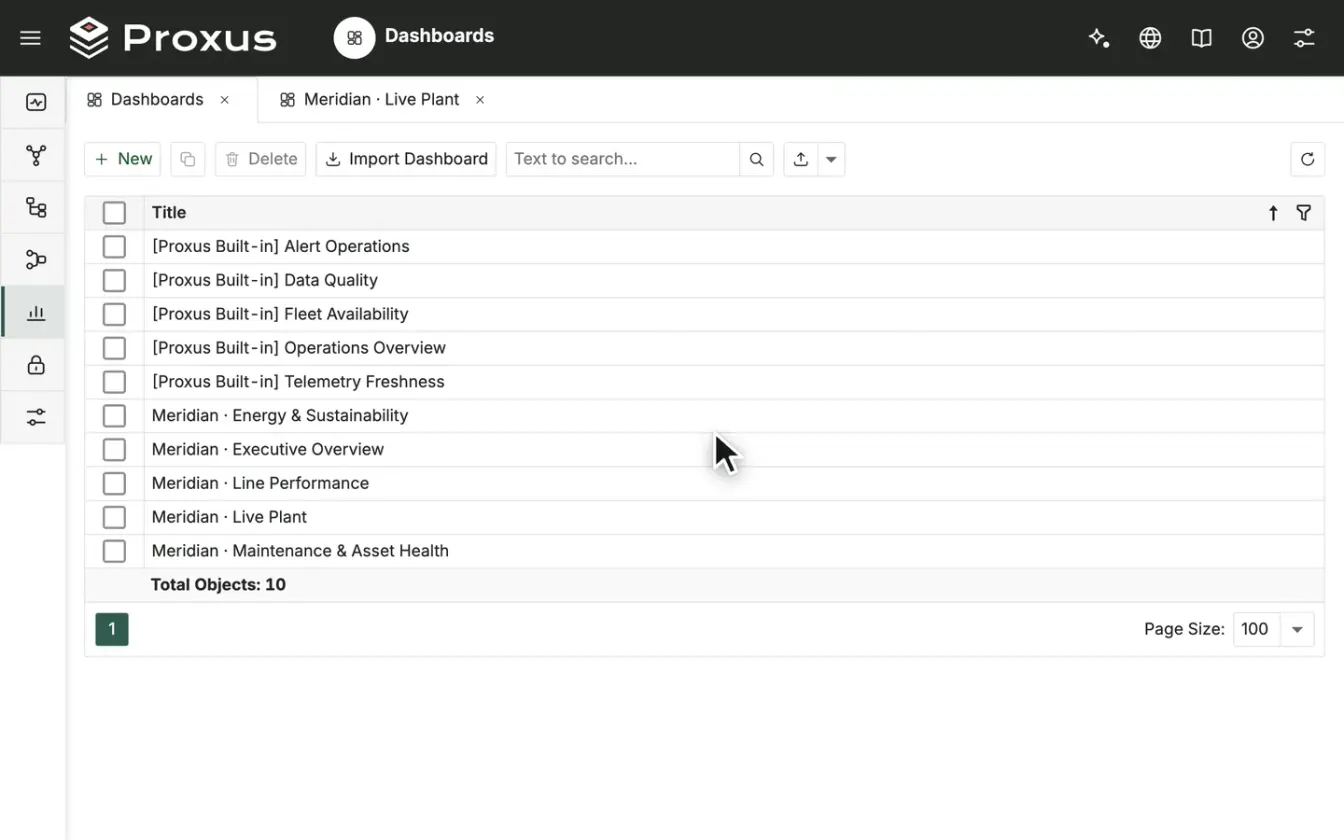
At the end of the reporting period, the goal is to prepare a reproducible record: meter history, production context, applied factors, and report outputs that can be reviewed and challenged. The value is not magic one-click compliance, but shorter preparation time and clearer traceability. In Proxus that record lives in the historian and is read out through dashboards and reports.
Use Compliance Work to Improve Data Discipline
CBAM is first a compliance requirement, not a marketing slogan. Still, the same measurement discipline that helps with CBAM can also improve internal energy accounting, product-level cost attribution, and audit preparation. For export-heavy manufacturers, those operational improvements can matter even before any external commercial benefit appears.
When this may not be suitable
- Lower-frequency telemetry may not justify full distributed complexity.
- Small single-line plants may prefer simpler architectures first.
- Strict legacy constraints may require phased adoption.
- Safety-critical closed-loop control should remain in PLC/Safety PLC layers.
Observed performance depends on workload shape, node capacity, and deployment design.
Frequently Asked Questions
When does CBAM become financially mandatory?
The transitional period ran from October 2023 through December 2025. The definitive regime applies from 1 January 2026. Under the current framework, importers above the applicable 50-tonne annual mass threshold for covered goods generally need authorised CBAM declarant status, subject to exclusions and product-specific rules. Certificates associated with 2026 imports are reported and surrendered on the current statutory timetable, including the first annual declaration and surrender deadline of 30 September 2027. Verify these dates and scope before acting because implementing rules may change.
Which industries does CBAM affect?
The current scope includes specified CN codes in cement, iron and steel, aluminium, fertilisers, electricity, and hydrogen, plus certain precursors and downstream goods. Coverage is determined by the regulation's annexes and current implementing rules, not by a sector label alone.
How does ISO 50001 help with CBAM compliance?
ISO 50001 can support disciplined metering, baselines, responsibilities, and data-quality review, but certification does not establish CBAM compliance. The CBAM calculation and verification method must still be applied to the covered installation, process, precursor, and goods data.
References
- Consolidated Regulation (EU) 2023/956 - The current consolidated CBAM regulation, including amendments applicable to the definitive regime. EUR-Lex
- European Commission - CBAM Definitive Regime - Current scope, threshold, authorisation, certificate, declaration, and implementation guidance. European Commission
- European Commission - CBAM Legislation and Guidance - Implementing acts, guidance documents, and current legal resources. European Commission
- ISO 14064-1 - A general greenhouse-gas quantification and reporting standard; use it only where it aligns with the applicable CBAM method.
Last updated August 6, 2026