
Dec 30, 2025 · 7 min read
Methodology notes
What is Smart Filtering in Edge Computing?
Pumping raw sensor data into the cloud can increase costs. Smart Filtering can reduce ingress volume depending on threshold settings, sampling rate, and process dynamics.
- Evidence level: Medium (field observations + public standards; not a universal benchmark).
- Measurement scope: Performance and economic outcomes vary by hardware, topology, workload shape, sampling profile, and process constraints.
- Primary references: IEC 62443, ISA-95 / IEC 62264, NIST SP 800-82r3.
- Implementation docs: Edge Architecture and Unified Namespace.
The Cloud Ingress Trap
Over the years, I've watched dozens of greenfield IIoT projects stall under data volume and cost pressure-not because the technology was wrong, but because they tried to stream everything without filtering. When organizations launch their first Industrial IoT (IIoT) initiative, the initial instinct is usually the same: "Let's connect all our PLCs to AWS/Azure and stream everything."
This "Cloud-First" mentality sounds great in a boardroom, but it usually crashes on the factory floor for a very simple economic reason: Physics and Finance.
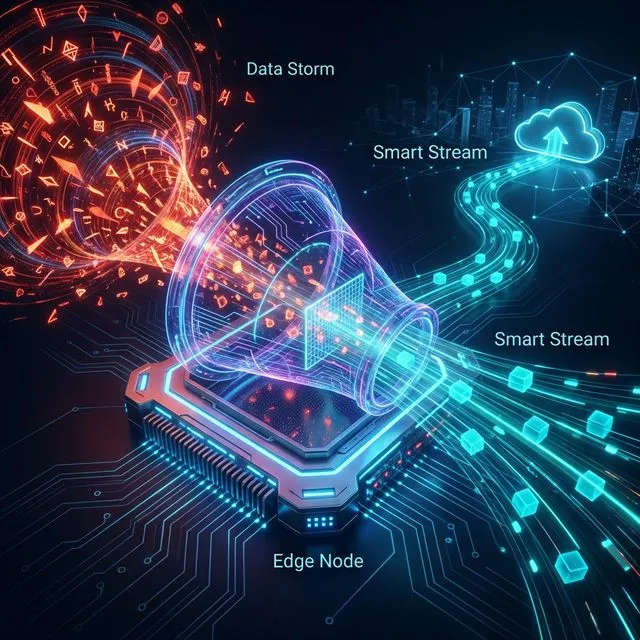
A modern PLC or vibration sensor can sample data every 10 milliseconds. If you have 500 sensors across a manufacturing line, you are producing a Data Storm-millions of data points per hour. Sending all of this raw, unfiltered noise over 4G/5G connections (and paying the cloud provider's ingress and storage fees for every byte) is a phenomenally expensive way to discover that a machine's temperature was perfectly normal.
This is why modern industrial architectures rely on Smart Filtering at the edge.
Context: Reduction percentages depend primarily on sensor type and deadband settings. Slow-moving values (ambient temperature, tank level) with 1-2% deadband achieve 80-95% reduction. High-frequency signals (motor vibration at 1kHz, instantaneous power) achieve 30-50% reduction even with aggressive filtering.
Observed performance depends on workload shape, node capacity, and deployment design.
What is Smart Filtering?
Smart Filtering (often coupled with Edge Analytics) is the process of examining, reducing, and aggregating raw machine data before it leaves the physical factory building.
Instead of treating the edge gateway as a dumb pipe that blindly ferries data to the cloud, Smart Filtering turns the edge into a highly intelligent bouncer. It looks at every single data packet generated by the PLC and decides: "Is this valuable enough to pay to send to the cloud?"
If the answer is no, the data is discarded or averaged locally. If the answer is yes, the data is instantly forwarded.
High-Freq Sensor
10ms Sampling
Proxus Edge
Smart Filter & Deadband
Cloud Storage
Optimized Data
How Smart Filtering Reduces Bandwidth by 90%
A proper edge computing platform employs three primary filtering strategies to convert a massive "Data Storm" into a highly optimized "Smart Stream":
Deadbanding (Change-of-State)
In many industrial processes, a value doesn’t change for hours. Why send a temperature reading of 72°C every second for a straight hour? With Deadbanding, the Edge Gateway is configured to only send a new payload to the central Unified Namespace (UNS) if the value changes by a specific percentage or absolute amount (e.g., only update the cloud if the temperature changes by more than 1°C). This simple rule alone can eliminate 80% of unnecessary network traffic.
Time-Based Aggregation
Sometimes, you don't care about the microsecond fluctuations; you just want the trend. Smart Filtering allows the Edge Gateway to collect 600 high-frequency readings over a minute, calculate the Average, Min, and Max, and send a single, combined payload every 60 seconds. You retain total operational visibility while drastically slashing your GSM data usage.
The most advanced form of filtering. The Edge Gateway runs continuous localized logic (such as a local Rule Engine). It monitors a high-speed vibration sensor on the local network and can avoid routine cloud transmission until the vibration crosses a warning threshold. Then it streams high-resolution data surrounding the anomaly to the cloud for deeper analysis.
The Proxus Approach to Edge Filtering
At Proxus, we recognize that Edge Computing is fundamentally an exercise in bandwidth and cost optimization.
When you deploy a Proxus Edge Gateway, it isn't just a protocol converter; it is a full Local Rule Engine. From the central Proxus Platform, you can deploy orchestration configurations down to the Edge Gateway. Without writing a single line of custom Python code, you can use built-in functions to:
- Normalize tags (converting raw PLC registers into clean JSON).
- Apply Deadbands (Absolute and Percentage).
- Buffer data (Store and Forward) to prevent loss during outages.
- Route critical alarms to local factory sirens, while routing aggregated metrics to the cloud.
Public transportation authorities use Proxus Edge in highly constrained mobile networks. By filtering redundant GPS paths, engine telemetry, and passenger counts locally inside the vehicle, they maintain real-time fleet visibility while immediately reducing GSM data costs by over 40%.
Conclusion
Data has gravity. The closer you can process it to the source, the cheaper, faster, and more secure your industrial architecture becomes.
Smart Filtering represents the maturity of Edge Computing. By purposefully restricting the sheer volume of data sent to the cloud, manufacturers aren't losing visibility - they are eliminating noise. The result is a highly efficient, hyper-responsive data architecture.
When this may not be suitable
- Lower-frequency telemetry may not justify full distributed complexity.
- Small single-line plants may prefer simpler architectures first.
- Strict legacy constraints may require phased adoption.
- Safety-critical closed-loop control should remain in PLC/Safety PLC layers.
Outcomes depend on workload profile, hardware capacity, and deployment topology.
Frequently Asked Questions
Won't filtering discard data I might need later?
Not if configured correctly. Smart Filtering eliminates redundant data (identical consecutive values, sub-threshold jitter), not anomalous data. Configure exception-based reporting with appropriate deadbands per sensor type. For audit-critical signals (safety, energy metering), bypass filtering for those signals and log every sample.
What is a deadband and how do I set it?
A deadband defines the minimum change threshold before a new value is transmitted. For a temperature sensor with ±0.5°C accuracy, a 1°C deadband is sensible - changes smaller than sensor accuracy are noise. For vibration monitoring used in predictive maintenance, use much tighter deadbands (or none) to capture high-frequency patterns.
How does Smart Filtering interact with Store and Forward?
They work in sequence: Smart Filtering reduces the volume of data generated, Store and Forward ensures the delivery of the remaining data during outages. Together they minimize both bandwidth costs and data loss risk.
References
- OPC UA Part 8 (Data Access) - Defines deadband filtering for analog items, the standard model adapted by many edge platforms.
- ISA-95 / IEC 62264 - Provides the data categorization framework for determining which data to filter vs. preserve.