
Feb 17, 2026 · 9 min read
Methodology notes
Using the Actor Model for High-Rate Industrial Event Processing in IIoT
Why traditional SQL-based databases fail under heavy industrial data loads, and how the Actor Model enables low-latency, scalable architectures in Industry 4.0.
- Evidence level: Medium (field observations + public standards; not a universal benchmark).
- Measurement scope: Performance and economic outcomes vary heavily by hardware, network topology, workload shape, sampling profile, and process constraints.
- Primary references: IEC 62443, ISA-95 / IEC 62264, NIST SP 800-82r3.
- Implementation docs: Edge Architecture and Unified Namespace.
The Actor Model in IIoT: Building Resilient Concurrent Systems
Across years of building industrial software, teams often encounter a common architectural scaling limit: treating high-velocity factory data identically to standard transactional IT data.
When a standard REST API backend is connected to a traditional relational database (like PostgreSQL or Microsoft SQL Server), PLCs are often mapped directly to database tables. This approach is frequently sufficient for localized pilot projects with low sensor counts.
However, transitioning to full-scale production introduces significant challenges. A high-speed packaging line can generate tens of thousands of state changes per second, per line. If a system attempts to write all these events simultaneously to a standard SQL database, it often encounters table locks, thread pool exhaustion, and latency spikes that delay dashboard updates and rule execution. Traditional IT architectures often struggle with the high concurrency and velocity requirements of factory floor data.
To build a low-latency IIoT platform that scales across multiple sites, the fundamental approach to state and concurrency must be re-evaluated. This is where the Actor Model becomes highly relevant.
Important: Latency figures assume in-process message passing on the same machine. Remote actors across a network typically add 50-500µs due to serialization and network transit. Results heavily depend on workload profile, hardware capacity, and deployment topology.
Concurrency Challenges: Threading vs. Factory Scale
To understand the Actor Model, it is helpful to examine why traditional shared-state Object-Oriented architectures often struggle at industrial scale.
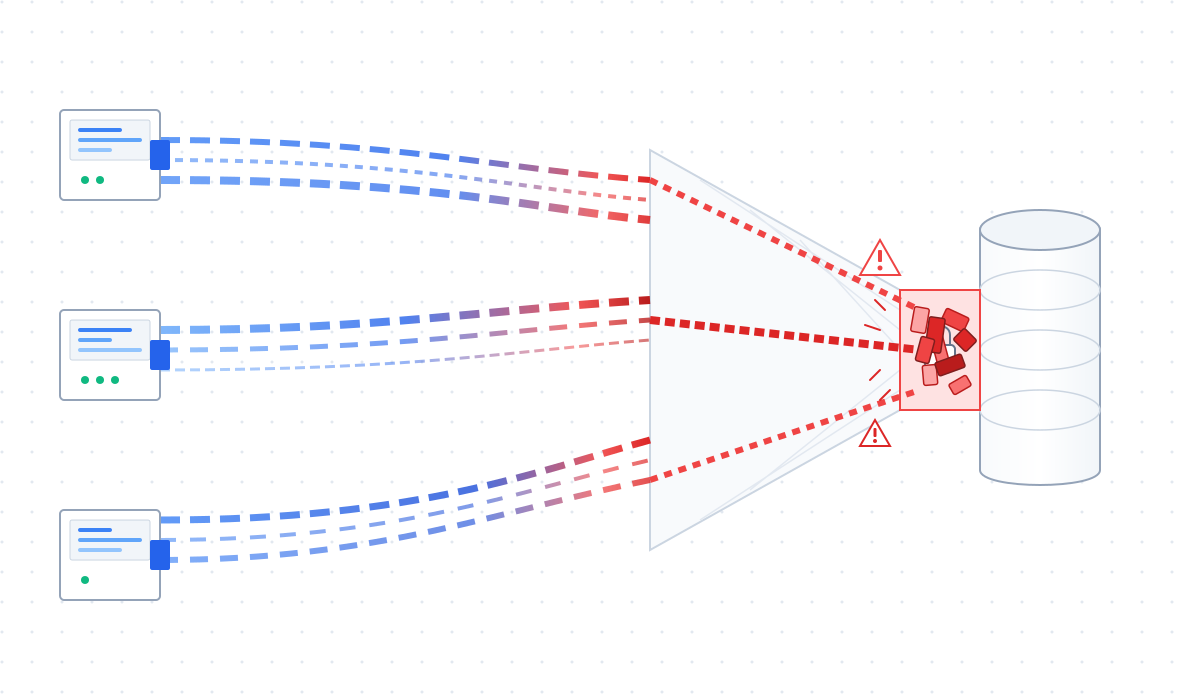
In a standard C# or Java application, if 5,000 sensors send data at the exact same moment, the runtime relies on thread pools, async I/O, and internal queues rather than spawning 5,000 discrete OS threads. Under sustained burst load from industrial equipment, this can still create queue growth, lock contention, and latency spikes.
If two sensor events try to update the same machine state simultaneously, a "race condition" can occur, potentially leading to inconsistent state calculations. To prevent this, engineers implement "Locks."
Lock contention limits throughput. While Thread A updates a machine's state, Threads B, C, and D must wait. As data volume increases, this contention compounds. Servers end up spending significant CPU cycles managing thread synchronization rather than processing actual operational data.
Enter the Actor Model: Distributed Decoupling
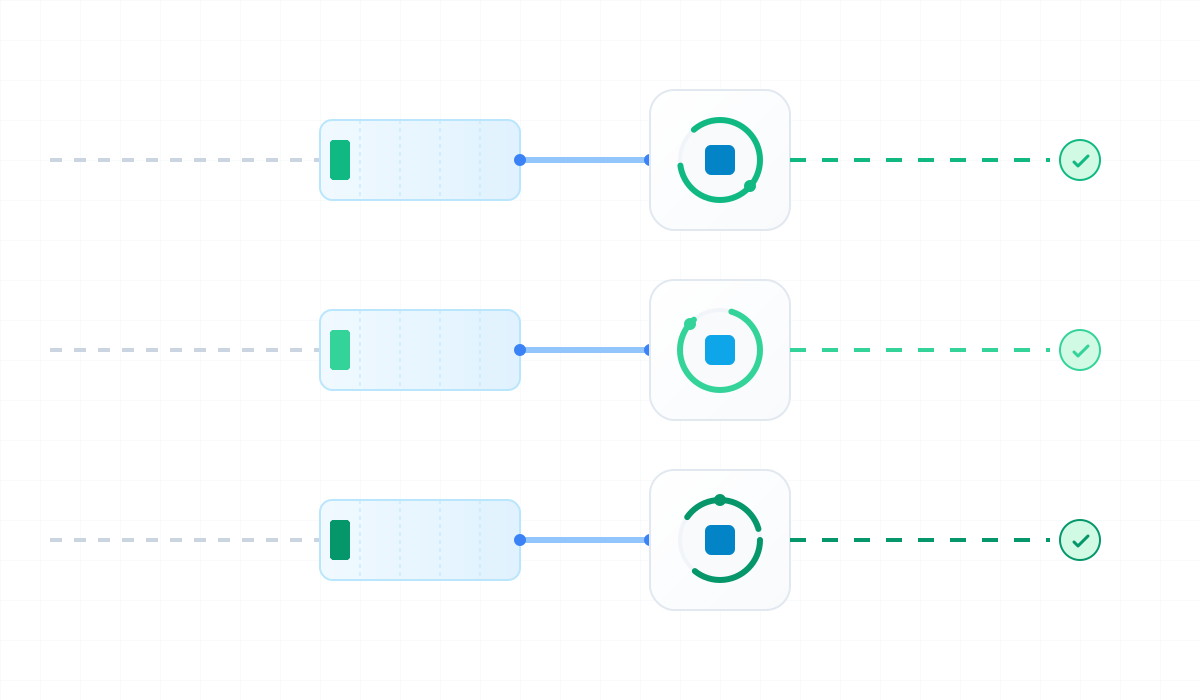
Instead of protecting shared memory with locks, each actor owns its own data exclusively. This reduces a major source of thread contention and supports predictable scalability when supervision, mailbox sizing, and backpressure are configured correctly.
The Actor Model is a mathematical model of concurrent computation proposed in 1973. It forms the backbone of highly reliable distributed systems (such as Erlang-based telecommunications infrastructure).
In this model, the fundamental unit of computation is the "Actor." An Actor is a microscopic, highly isolated execution context. It encapsulates its own private state, its specific behavior, and a private "Mailbox."
The core principles are:
- No Shared State: Actors do not share memory. This drastically reduces the need for application-level locks, as isolated execution contexts do not compete to modify the same mutable variables.
- Asynchronous Messaging: Actors communicate only by sending fire-and-forget messages to each other's Mailboxes.
- Sequential Processing: An Actor reads messages from its Mailbox strictly one at a time. It processes the message, updates its private state, and then moves to the next message.
How This Applies to the Factory Floor
Consider a factory floor with 1,000 physical motors. In an architecture designed for the Unified Namespace, the system provisions 1,000 independent "device actors" in memory.
- Each device actor operates as an isolated process in memory.
- It acts as the explicit digital twin for one specific physical motor.
- When the physical motor generates 50 vibration alerts in a single second, those messages are routed directly into that specific device actor's mailbox.
- The actor sequentially processes them in microseconds, evaluates any associated Industrial Rule Engine logic, updates its internal state, and outputs the result with sub-millisecond processing latency (excluding network transport).
Because these actors do not share memory, the underlying runtime can distribute their execution across all available CPU cores in parallel with minimal contention.
The Core Distributed Engine
Building a resilient, actor-based system requires careful distributed systems design. To achieve low-latency telemetry across highly distributed OT networks, modern IIoT architectures often rely on high-performance, cross-platform implementations of the Actor Model.
In-Memory Speed, Database Persistence
By maintaining real-time factory state in memory across isolated actors, platforms can calculate metrics like OEE with microsecond-range latency under optimal conditions. To fulfill historical requirements, actors asynchronously persist data to time-series databases (such as ClickHouse) in the background, ensuring database write-latencies do not block live stream processing.
Resilience Through Supervision Trees
Industrial networks are inherently hostile environments. Sensors lose power, gateways drop connections, and network switches fail.
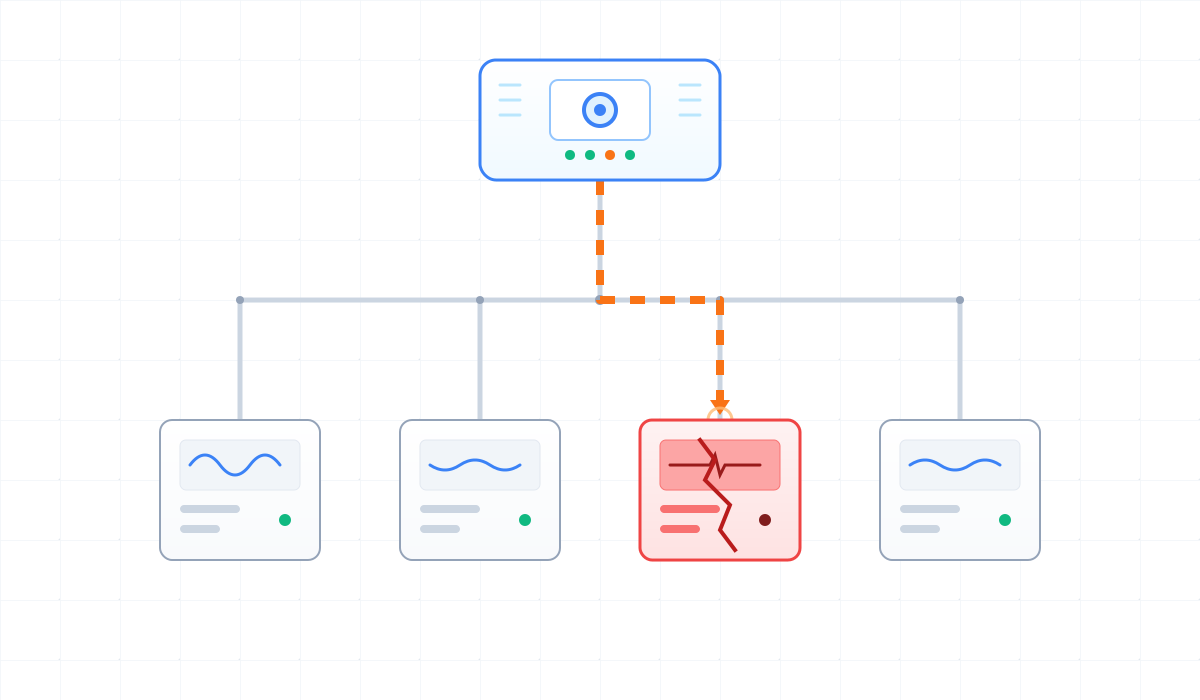
In an Actor system, components are organized in a hierarchy known as a Supervision Tree. If a protocol actor (responsible for maintaining a TCP socket with a Siemens PLC) crashes due to a sudden network timeout, its "Parent Actor" detects the failure, restarts that specific child actor, and resumes data collection. This containment strategy isolates failures and prevents cascading system crashes.
Location Transparency and Horizontal Scaling
When an alarm actor needs to dispatch an alert to a machine actor, it does not need to know if that target actor is running on the same local server or on an Edge Computing Gateway in a different facility. The underlying framework routes messages across the network automatically. This location transparency enables horizontal scaling simply by adding more hardware nodes to the cluster, which is essential for Edge Computing Patterns operating at scale.
Bypassing the Relational Bottleneck
Attempting to force high-velocity Industry 4.0 data through traditional relational database architectures often results in latency penalties and inflated cloud compute costs under heavy load. By leveraging actor-style concurrency, modern IIoT platforms can process massive volumes of industrial events while maintaining the low-latency guarantees required by operational teams.
Architecture Trade-offs: When this may not be suitable
- Low-frequency telemetry: Use cases monitoring ambient temperature every 15 minutes may not justify the architectural complexity of a fully distributed actor system.
- Single-line deployments: Small, isolated plants might achieve their goals faster with simpler, monolithic architectures.
- Safety-critical control: Hard real-time, safety-critical closed-loop control must permanently reside within the PLC/Safety PLC layer.
Performance metrics and outcomes will always vary based on specific workloads, physical hardware, and network topologies.
Frequently Asked Questions
What is the Actor Model in simple terms?
Each "actor" is an independent, lightweight computational entity with its own private state and mailbox. Actors communicate exclusively through asynchronous messages, which minimizes shared memory access. This strongly reduces common threading hazards (like deadlocks and race conditions), though engineers must still carefully design for message ordering, backpressure, and supervision.
How does the Actor Model compare to other approaches?
Actors are significantly lighter than microservices within the same process boundary. Microservices typically communicate over HTTP/gRPC, introducing serialization and network overhead. Actors can pass messages in-process with negligible overhead.
Use actors for: In-process concurrency, sub-millisecond latency requirements, and managing tens of thousands of concurrent digital twins. Use microservices for: Defining organizational boundaries, independent service scaling, and technology heterogeneity.
Think of actors as the concurrency model inside a service, while microservices define the deployment boundary.
Thread pools with shared state heavily rely on locks, causing CPU contention under high load. With 100,000 rules evaluating simultaneously, lock contention becomes a severe bottleneck.
Actors minimize shared-state locking. Each actor processes its own mailbox sequentially, while the runtime efficiently schedules these workloads across available hardware threads.
| Property | Thread Pool | Actor Model |
|---|---|---|
| Memory per unit | Thread stack + scheduler overhead | Mailbox + internal state footprint |
| Concurrency limit | Bounded by thread pool sizing | Bounded by mailbox depth and hardware RAM |
| Lock overhead | High under contention | Minimized via isolated state |
| Scalability | Vertically limited | Horizontally distributable |
Async/await patterns (common in Rust, C#, JavaScript) excel at I/O-bound workloads but do not inherently solve concurrent state management. Developers still require locks, semaphores, or channels to coordinate shared data safely.
The Actor Model combines asynchronous messaging with strictly isolated state, heavily reducing synchronization complexity.
References
- Carl Hewitt, Peter Bishop, and Richard Steiger, "A Universal Modular ACTOR Formalism for Artificial Intelligence" (1973) - The seminal paper defining the Actor Model of computation, indexed in the ACM Digital Library.
- Microsoft Orleans Documentation - Official overview of the virtual actor pattern and distributed systems scalability for .NET.
- Erlang/OTP Concurrent Programming Guide - Official reference for Erlang's industrial-grade implementation of actor-style concurrency.