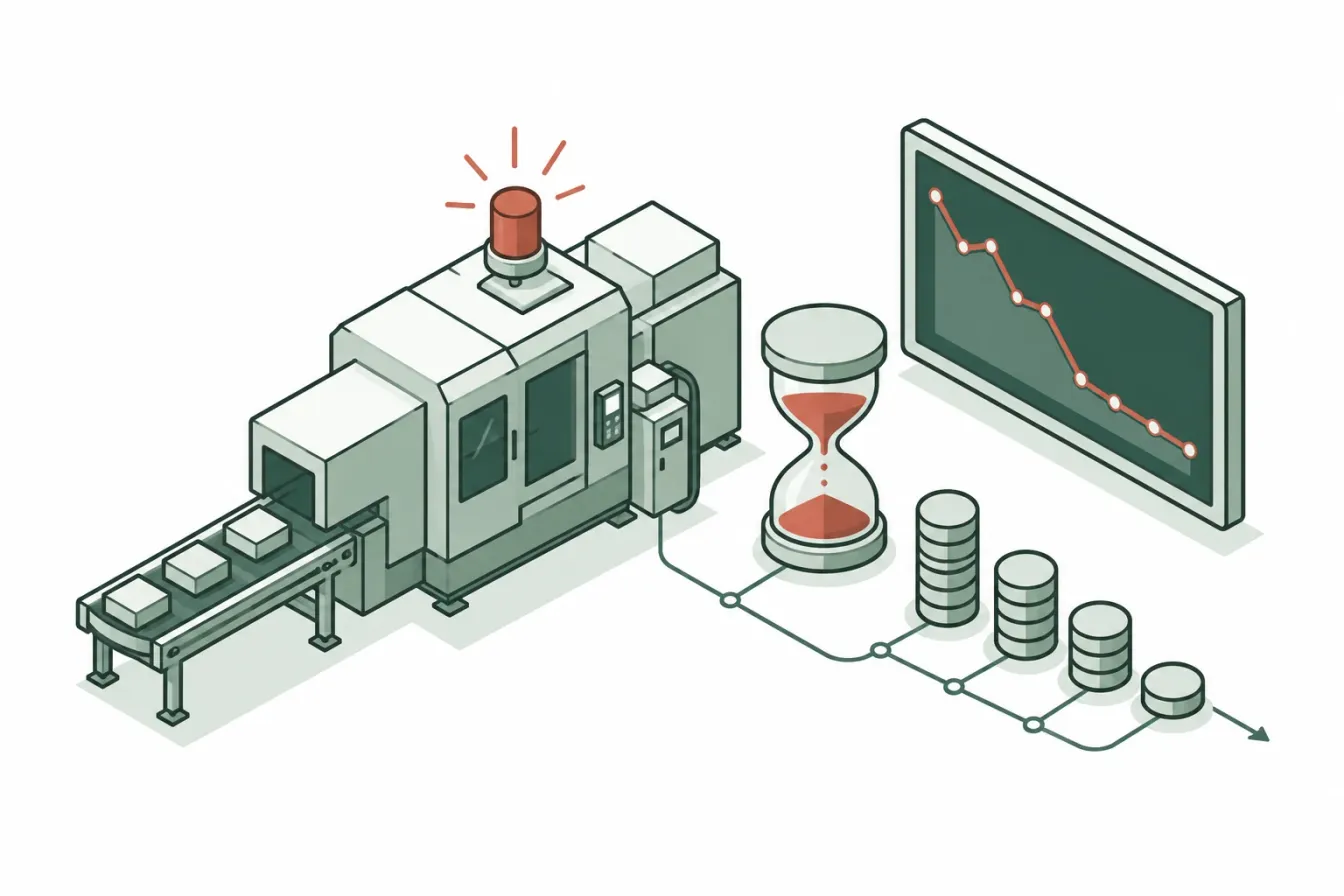
When a critical CNC machine or packaging line stops unexpectedly, everyone sees the clock. What is less visible is how many different cost buckets begin moving at once: lost production, idle labor, scrap, recovery energy, late-delivery exposure, and planning disruption.
Many teams already track downtime, but they often track it too narrowly. If the calculation stops at labor plus spare parts, the number may be directionally useful for maintenance records while still being too small for capital-prioritization decisions.
This guide separates the main cost categories behind unplanned downtime, explains why late alarms rarely prevent the event itself, and shows how condition monitoring data can support a more preventive maintenance model.
- 4: Core downtime cost categories
- Indirect: Costs often missed in basic TDC math
- Condition-based: Maintenance trigger model enabled by IIoT
Observed performance depends on workload shape, node capacity, and deployment design.
What Does Downtime Actually Cost?
Published estimates of hourly downtime cost vary enormously, and they are rarely comparable: each study picks its own sectors, assets and cost items. A figure from another plant tells you little about your own line.
What decides your number is the asset and the line it sits on: the value of the output it stops, how hard the line is to restart, the service levels you owe customers, and whether the lost production can realistically be made up later. A bottleneck asset on a sold-out line and a machine with spare capacity behind it can differ by orders of magnitude. Build the figure from your own site data instead.
To calculate your True Downtime Cost (TDC), you typically should account for both tangible and intangible variables across four distinct categories.
Downtime Cost Breakdown by Category
| Item | % of total cost |
|---|---|
| Lost Production | 40 |
| Supply Chain Penalties | 25 |
| Direct Labor | 20 |
| Material Scrap | 15 |
Illustrative split for a bottleneck asset, not a benchmark. Build your own from the site's figures.
Direct Labor and Emergency Repair Costs
This is what everyone calculates first. It is the easiest metric to pull from HR.
- Idle Direct Labor: The hourly wages of the 5 operators standing around waiting for the machine to restart.
- Maintenance Overtime: The time-and-a-half wages paid to the emergency maintenance crew called in at 2:00 AM on a Sunday.
Lost Production Capacity
You are not just losing time; you are losing the physical goods you intended to sell.
- For example, if a line produces 500 units per hour and the contribution per unit is USD 10, four hours of lost output represents USD 20,000 of production opportunity before considering inventory, demand, and recovery capacity.
Material Scrappage and Energy Waste
When a continuous process (like a plastic extruder or a food baking oven) stops abruptly, the material currently inside the machine is often ruined.
- Scrap Material Cost: The raw material that typically should be thrown away.
- Disposal Fees: The cost to physically haul away and recycle the hardened plastic or burnt food.
- Re-tooling Energy: The massive spike in electrical kW required to reheat the oven or bring the compressor back up to operating pressure from a cold start.
Contractual and Operational Consequences
These effects can be material but must be calculated from the site's contracts and operating model.
- Supply Chain Penalties: Late-delivery or line-stop provisions may apply where they are explicitly defined in the customer contract.
- Brand Reputation: A customer switching to a competitor because they can no longer trust your lead times.
- Employee Morale: Maintenance teams burning out from constant "firefighting" mode, leading to high turnover and loss of tribal knowledge.
The True Downtime Cost (TDC) Formula
To find your baseline, use this simplified formula for a specific bottleneck machine:
TDC = (Lost Revenue per Hour) + (Idle Labor per Hour) + (Maintenance Repair Costs) + (Scrap/Energy Costs) + (SLA Penalties)
Once this number is calculated for a critical asset, the team can compare instrumentation and workflow investment against a transparent site-specific baseline.
Illustrative cost breakdown: a bottleneck assembly line
An invented example, to show how the categories add up for a critical assembly line in heavy manufacturing:
True Downtime Cost: 1-Hour Unplanned Stoppage
| Item | USD / hour |
|---|---|
| Lost Production Revenue | 450,000 |
| SLA Customer Penalties | 25,000 |
| Labor (Overtime + Maintenance) | 15,000 |
| Material Scrap / Energy | 10,000 |
| Supply Chain Disruption | 30,000 |
Why Legacy Alarms Rarely Prevent the Event
If downtime is so expensive, why does it still happen so frequently? The answer lies in the architecture of legacy automation.
Most factories rely on basic PLC thresholds and SCADA alarms. If a motor's temperature exceeds 85°C, a red light flashes on an HMI and an alarm horn sounds.
This is a reactive architecture. By the time the temperature actually hits 85°C and the alarm triggers, the bearing has already seized, the motor has already burnt out, and the downtime event has already begun. This approach reacts to failures rather than preventing them.
To prevent the failure, you typically should detect the anomaly that occurs weeks before the hard threshold is breached.
The Solution: Moving from Reactive to Predictive at the Edge
One way to reduce some failure-driven downtime is to combine suitable condition monitoring with preventive and predictive maintenance. It is not appropriate for every failure mode or asset.
This requires constant, high-frequency analysis of machine vibration, acoustics, and power consumption signatures. However, you cannot stream 10,000 data points per second from every motor in your factory up to a Cloud AI server. The internet bandwidth costs would be astronomical, and the latency would render the AI useless.
Enter Proxus Edge Rules
The Proxus Edge Architecture flips this paradigm. Instead of sending the heavy data up to a central model, Proxus runs the first line of analysis next to the machine.
Step 1: High-Frequency Local Ingestion
A localized Proxus Edge Gateway connects directly to the PLC or raw vibration sensors, ingesting thousands of data points locally, without touching the external internet.
Step 2: Edge-Side Anomaly Detection
Proxus anomaly rules run statistical detectors (Z-score, IQR, moving average, rate of change, drift, flatline and gap) on the edge gateway itself, in real time or on a schedule. They compare each signal against its own recent behaviour, the "healthy heartbeat" of that exact motor, and keep running when the network is down.
Step 3: Early Alerting
A validated model or rule may detect a deviation before a hard threshold is reached. If the alert passes the configured confidence and approval criteria, Proxus can send a maintenance recommendation to the CMMS for review, through a rule action or an outbound target such as REST. Lead time and accuracy must be measured for the specific failure mode.
The repair is executed during planned, zero-impact hours. Where the failure mode gives an early signal, unplanned downtime from it can drop.
Use Downtime Cost as a Prioritization Tool
Calculating True Downtime Cost is less about dramatic slides and more about prioritization. Once a plant knows which assets create the largest operational and financial disturbance, it can target sensing, alerting, and maintenance workflow changes where they matter most.
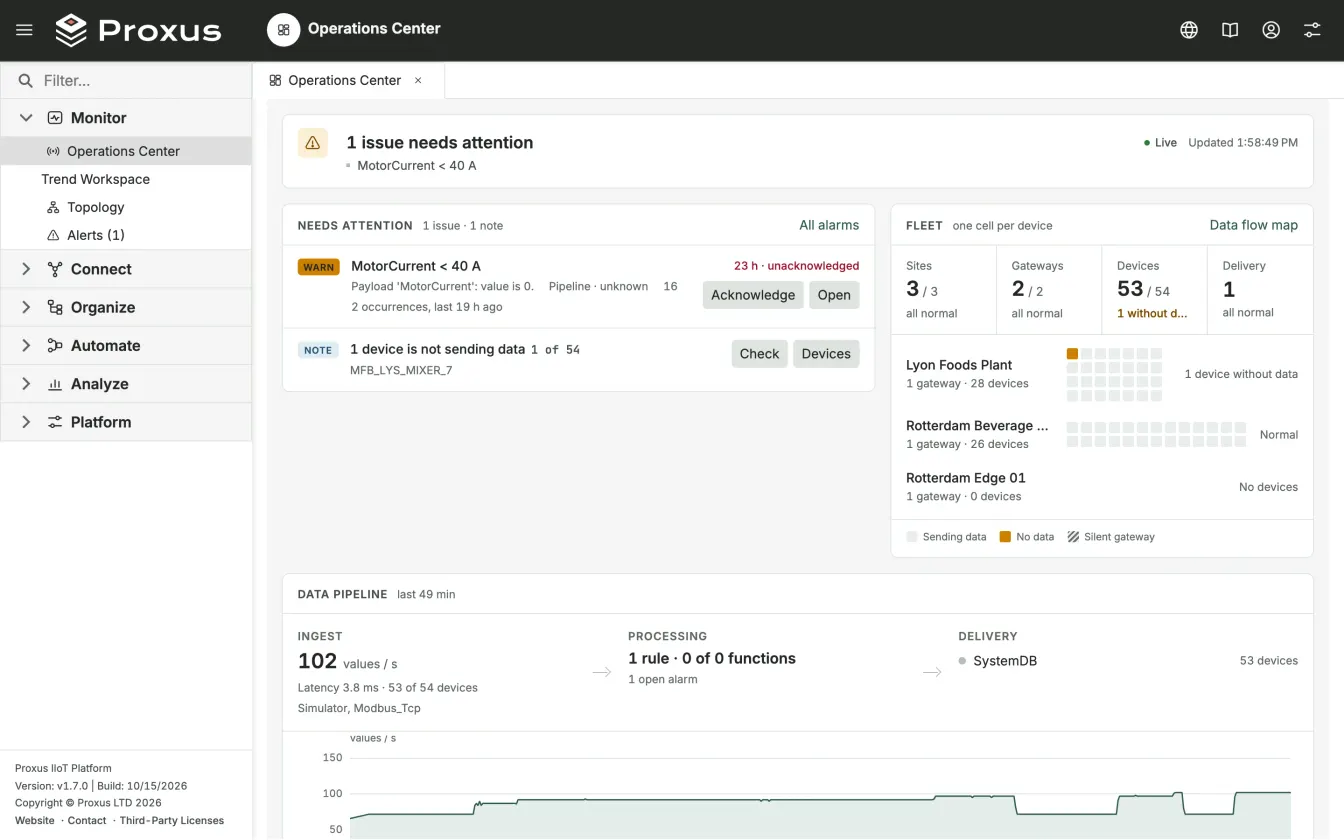
You do not need to replace legacy machinery to begin that process. A modern IIoT platform built on Edge Computing and Unified Namespace principles can add visibility and event handling around existing assets. Machine and OEE visibility shows how machine states and stop durations are captured from the controller, line by line, which is the record a downtime cost estimate starts from.
When this may not be suitable
- Lower-frequency telemetry may not justify full distributed complexity.
- Small single-line plants may prefer simpler architectures first.
- Strict legacy constraints may require phased adoption.
- Safety-critical closed-loop control should remain in PLC/Safety PLC layers.
Outcomes depend on workload profile, hardware capacity, and deployment topology.
Frequently Asked Questions
How do I calculate the true cost of downtime for my factory?
Downtime cost may include lost production contribution, idle labour, scrap or rework, contractual effects, and recovery overtime. Applicable terms and calculation methods depend on accounting policy, demand, inventory, and recovery capacity. Track defined components separately per line and relate them to OEE monitoring where appropriate.
What is the difference between predictive and preventive maintenance?
Preventive maintenance follows time-, usage-, or risk-based intervals. Predictive maintenance uses condition data and validated models to estimate degradation or failure risk. It can support better-timed intervention, but it does not determine an exact failure time for every asset.
How quickly can IIoT reduce unplanned downtime?
There is no universal timeline. Results depend on asset criticality, failure modes, sensor quality, baseline maintenance maturity, and whether the organization actually acts on early warning signals. In practice, the first measurable value often appears when teams use Rule Engine automation to separate real anomalies from routine noise on a small set of bottleneck assets.
References
- ISO 13381-1 - Condition monitoring and diagnostics of machines: Prognostics standard for remaining useful life estimation.
Last updated October 21, 2026