
v1.4.2: UNS Explorer & Core Performance
Introducing real-time UNS management, native MCP support for AI, and ClickHouse-powered logging for high-scale observability.
Version 1.4.2 delivers major advancements in platform management and data infrastructure. This release introduces the UNS Explorer for real-time visualization of the Unified Namespace, transitions system logging to ClickHouse for analytical scale, and standardizes AI integration via the Model Context Protocol (MCP).
🚀 Key Features
Model Context Protocol (MCP) Support
Proxus now natively supports MCP, establishing a standardized and secure interface for AI assistants (such as Claude or custom LLM agents) to interact with the platform.
- Secure Authentication: Built-in authentication with JWT token caching and session management.
- OData Proxy: Controlled access to platform entities (Device, Tag, Rule, Function) via safe proxies.
- Telemetry Querying: Read-only SQL access to ClickHouse telemetry data with injection protection.
- Schema Discovery: Automated documentation generation for platform entities and data models.
- Governance: Comprehensive rate limiting, IP whitelisting, and full audit logging of AI requests.
See the MCP Server documentation for integration details.
Azure Data Lake Storage Gen2 Integration
A new high-throughput outbound connector for Azure Data Lake Storage Gen2 (ADLS) is now available for big data workloads.
- Optimized Formats: Support for efficient Parquet (default), JSON, and CSV formats.
- Performance: Utilizes
RecyclableMemoryStreamfor efficient memory management during high-load telemetry export. - Throughput Control: Configurable buffering and batch flushing to optimize file sizes and network transmission.
- Security: OAuth2 authentication via Service Principal.
See the Azure Data Lake Integration guide.
Azure IoT Hub Connector
Added a production-ready outbound connector for Azure IoT Hub using the Azure Device SDK over MQTT.
- Device Authentication: SAS key-based device credentials.
- Retry & Timeout Controls: Configurable exponential backoff and operation timeouts.
- Consistent Payload Format: Flat telemetry schema aligned with AWS IoT exports.
See the Azure IoT Hub connector guide.
UNS Explorer Console
The new UNS Explorer provides a real-time interface for managing the Unified Namespace (ISA-95) hierarchy. It enables immediate visualization of tag structures, topic paths, and live data values with zero-latency updates.
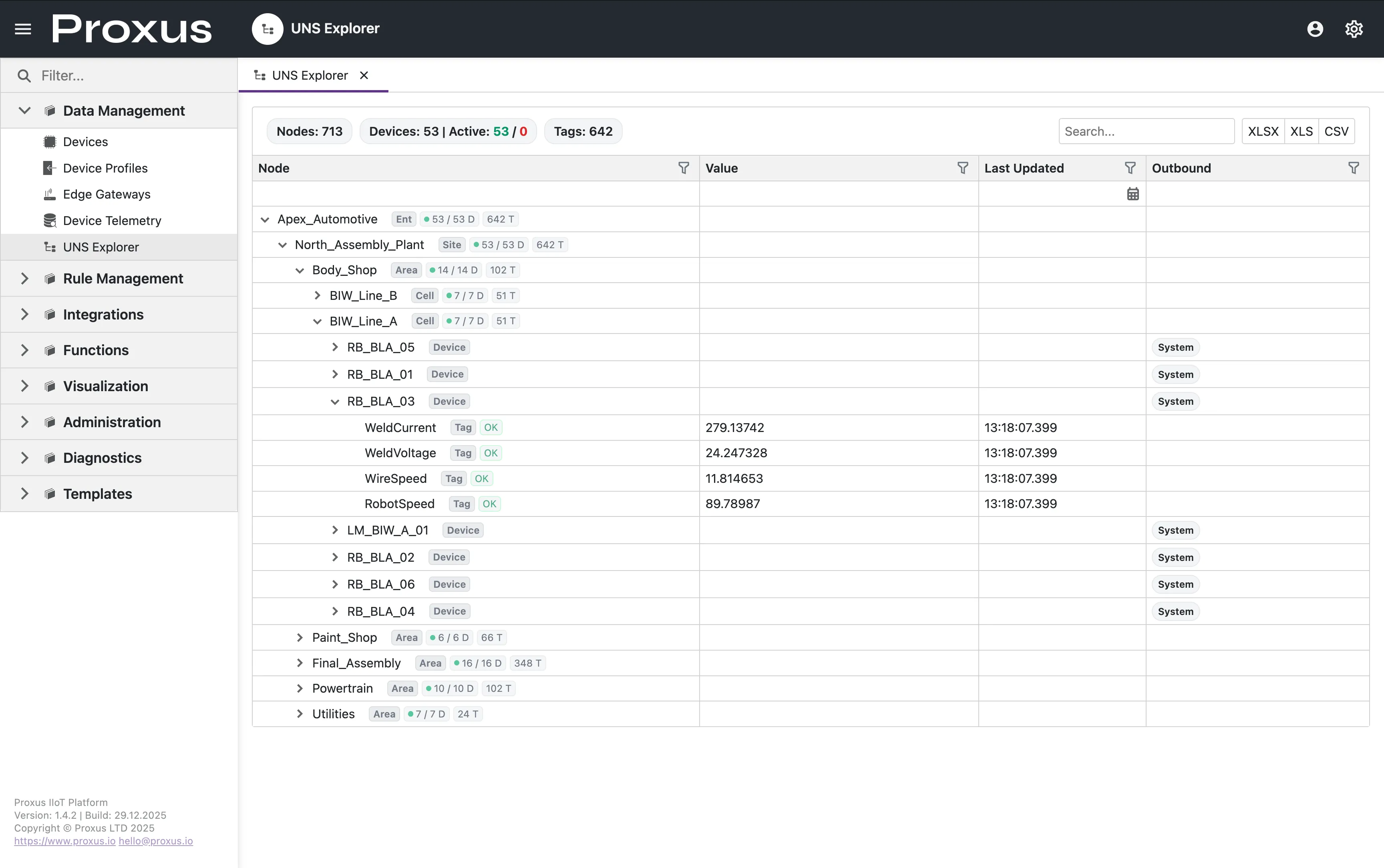
Learn more about UNS Explorer Navigation.
Device-Specific Connection Overrides
Device profiles can now be decoupled from specific connection parameters. A new Override Connection Parameters function allows operators to define unique connection settings (e.g., IP address, port) per device while maintaining a shared configuration profile.

See Device Management for details.
Granular UNS Topic Permissions (RBAC)
Role-Based Access Control has been extended to the UNS level, allowing for precise governance of data visibility.
- Path-Based Control: Define Allow/Deny rules for specific topic paths (e.g.,
/Plant/Line1/*). - Priority Logic: Specific path rules override general rules based on Longest Prefix Match.
- Hierarchical Visibility: Parent nodes remain navigable even if only specific child nodes are accessible.
- Management: Permissions can be managed directly via the context menu in UNS Explorer.
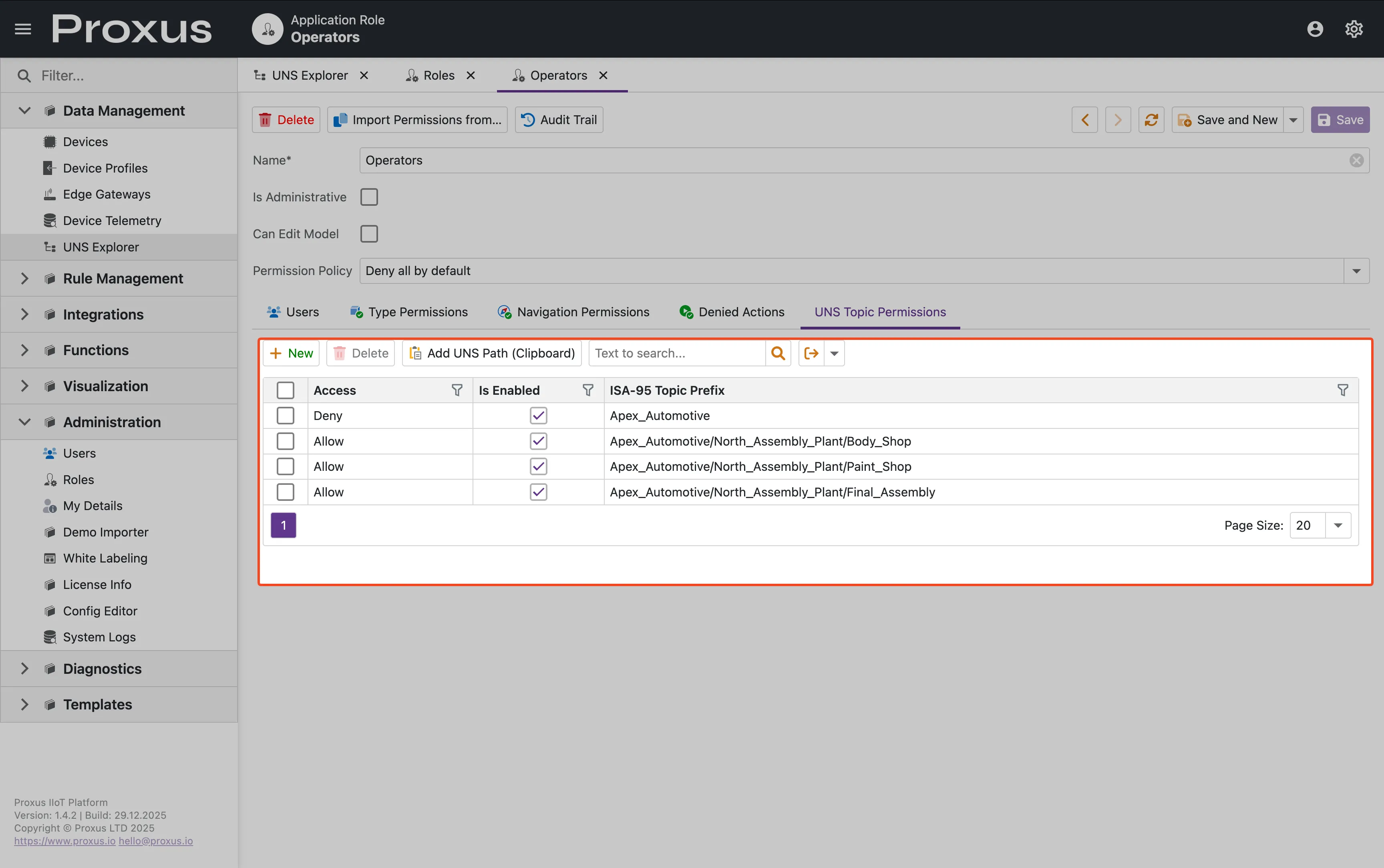
For configuration, see UNS Topic Permissions.
Technical Event Triggers
The Rule Engine criterion language has been expanded with two new system-level event types:
- LogReceived: Enables automation logic triggered by specific system diagnostic logs or security alerts.
- MetricsReceived: Facilitates real-time monitoring and alerting based on internal module performance metrics.
See Rule Engine Triggers.
⚡ Performance & Engineering
Re-engineered C# IntelliSense
The code completion engine has been architecturally overhauled to eliminate compilation latency.
- Latency Reduction: Completion response time is now consistently under 100ms.
- Context Awareness: Filtering logic now hides irrelevant keywords (
class,const) when accessing member properties. - Type Visualization: Accurate icon representation for Methods, Properties, Classes, and Interfaces.
- Snippet Library: Added shorthand snippets (
prxfun,prxsub,prxpub,prxlog) for rapid development.
[!TIP] The new experience aligns with VS Code standards. Try accessing a member via
.to test the responsiveness.
Monaco Editor Stability
Addressed initialization race conditions that could affect the code editor during page reloads.
- AMD Loader Isolation: Resolved conflicts between the Monaco loader and third-party libraries (Knockout, Vega).
- Lifecycle Management: Ensured reliable editor initialization across all navigation states.
- Dashboard Compatibility: Verified full support for XAF Dashboards without script collisions.
System Logs Migration to ClickHouse
System diagnostic logs have migrated from PostgreSQL to ClickHouse to support analytical scale.
- Query Performance: Log search operations are approximately 10x faster due to columnar storage optimization.
- Efficiency: High-ratio compression reduces disk footprint by up to 90%.
- Scalability: Architecture now supports extended retention periods without performance degradation.
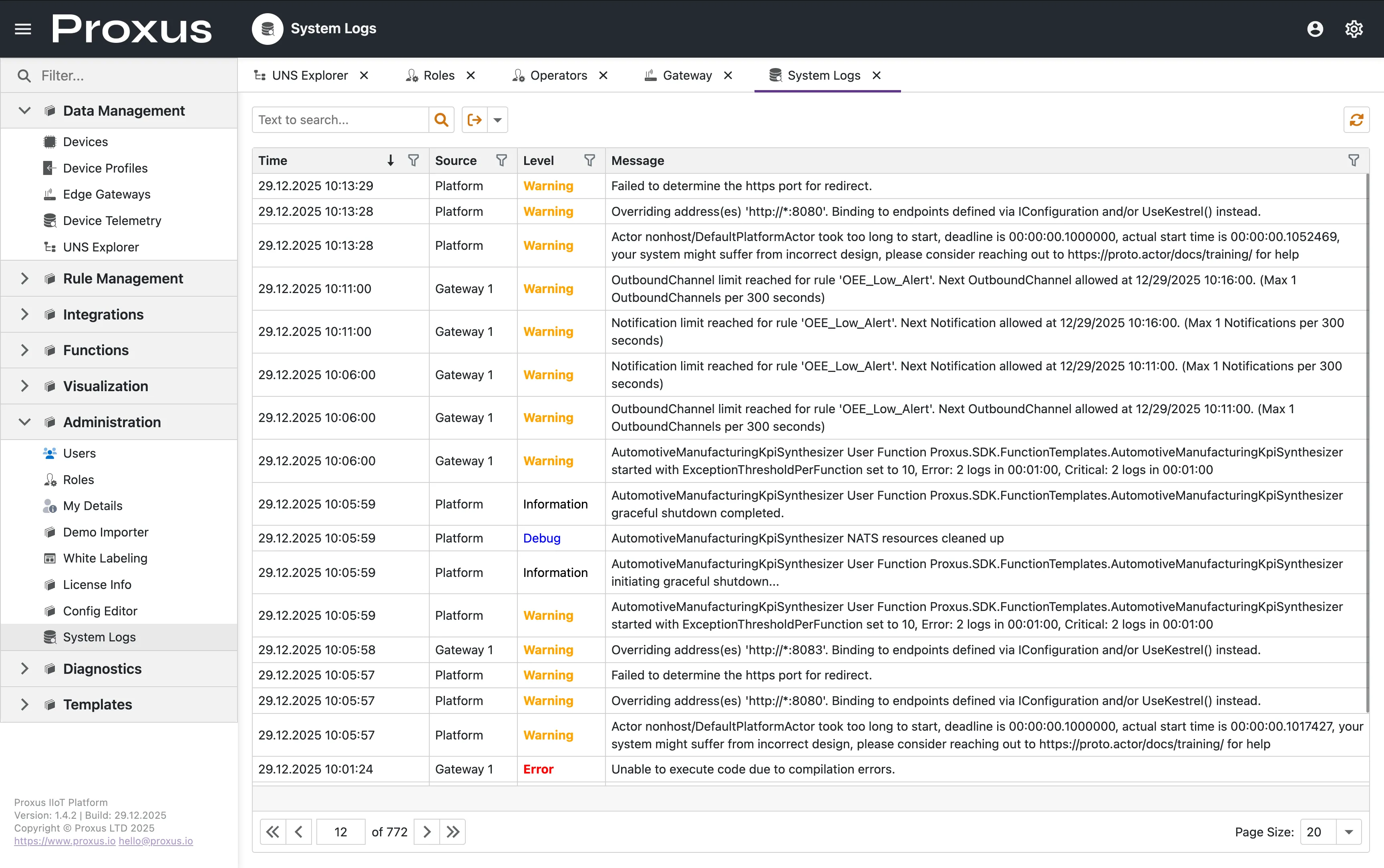
For query syntax, see System Logs.
Configurable Log Retention (TTL)
Log retention policies are now configurable via Proxus-config.toml:
[ClickHouse]
ClickHouseLogTTLExpression = "toDateTime(Time) + INTERVAL 45 DAY DELETE"
Default: 45 Days.
Gateway Status Visibility
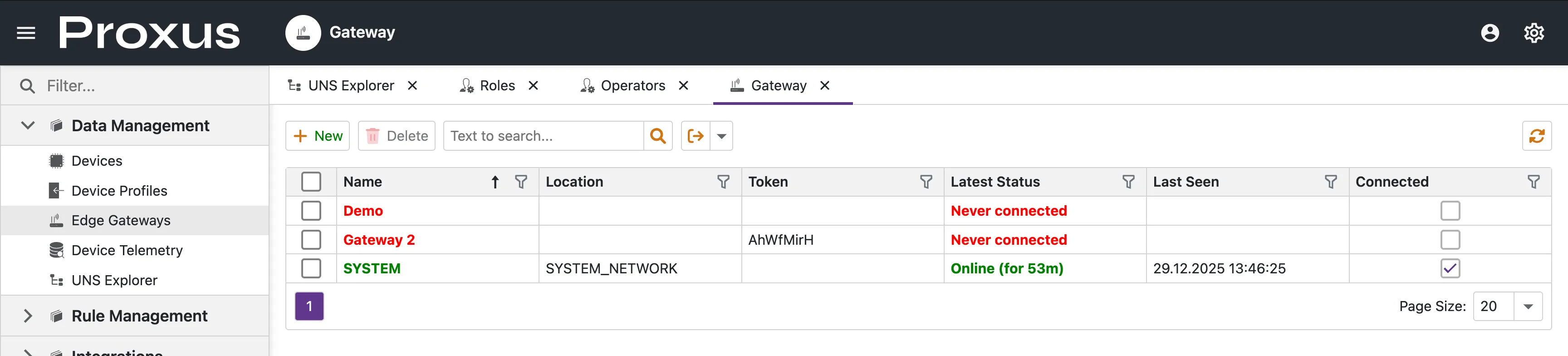
Gateway connection states now provide relative time context for better operational awareness.
- Status Detail: Displays "Online (for 2h 15m)" or "Last seen 5m ago" instead of static timestamps.
- Performance: Optimized list loading to remove connection-state dependent latency.
- Visual Indicators: Color-coded status columns for immediate recognition.
Lean Topic Architecture
Integrated a centralized TopicBuilder utility across all platform actors. This optimization prevents the generation of redundant topic segments (e.g., "default" placeholders), resulting in a flatter, more efficient MQTT hierarchy.
Advanced Tag Ingestion
The tag import system has been re-engineered for resilience with large datasets.
- Conflict Detection: Automated identification of duplicate names or address overlaps.
- Visual Validation: Real-time feedback on register address conflicts.
- Encoding Support: Enhanced BOM detection for reliable parsing of localized CSV files.

TLS Certificate Flexibility
Core services and the Management Console now support PEM formatted certificates in addition to PFX/PKCS#12. This facilitates deployment in Linux and containerized environments where PEM is standard.
Industrial Protocol Optimizations
- Siemens S7 PDU Negotiation: Automatic handling of Protocol Data Unit sizes for legacy S7-300/400 hardware, improving batch read reliability without manual tuning.
- Fast Read Path: Optimized data block reading logic to minimize communication overhead for high-frequency tags.
🛡️ Reliability & Security
Guaranteed Data Delivery
The message delivery subsystem has been hardened to ensure zero data loss during network instability or extended disconnection periods.
Device Metrics Persistence
Device statistics are now persisted to maintain data continuity.
- State Hydration: Metrics are reloaded from ClickHouse upon platform startup.
- Accumulation Logic: Counter values are preserved and accumulated rather than reset if an Edge gateway restarts.
- Flush Mechanism: Background synchronization to ClickHouse every 30 seconds and during graceful shutdown.
System-Wide Observability
All processing module logs and performance statistics are now streamed directly to the central EventStream, providing deep-level diagnostic visibility for orchestration tasks.

Legacy Database Migration
Automated migration logic for PermissionPolicyRole to ApplicationRole has been improved, ensuring seamless upgrades for deployments originating from older versions.
⚠️ Breaking Changes
MQTT Topic Structure Standardization
The MQTT broker now strictly enforces ISA-95 compliant topic structures.
Removed Topic Format: hooks/devicedata/{deviceId}
New Standard Format:
v1/{enterprise}/{site}/{area}/{processCell}/{equipmentModule}/{deviceName}/telemetry/{metric}
v1/{enterprise}/{site}/{area}/{processCell}/{equipmentModule}/{deviceName}/telemetry/_summary
v1/{enterprise}/{site}/{area}/{processCell}/{equipmentModule}/{deviceName}/state/_status
[!CAUTION] External systems subscribing to legacy
hooks/topics must be updated to the new ISA-95 paths immediately.
Configuration Updates:
- Removed:
UNSEnabled(UNS is now core to the platform). - Renamed:
UNSUseSparkplugB→UNSPayloadFormat(Values:"JSON"or"SparkplugB"). - Removed:
UNSDefaultEnterprise,UNSDefaultSite,UNSDefaultArea(Superseded by device metadata). - Removed:
UNSEdgeNodeUsername,UNSEdgeNodePassword.
New Optimization Settings: Refer to [UNS.Optimizations] in the MQTT Broker documentation.
🐛 Bug Fixes
Real-Time User Status Tracking
Fixed edge cases in CircuitHandler regarding user presence.
- Active Circuit Tracking: Accurately tracks active browser tabs per user.
- Retention Policy: Enforces a 30-second timeout to correctly mark users as "Offline" after disconnection.
- System Context: Bypasses security restrictions for internal status updates to ensure reliability.
Monaco Editor Initialization
Resolved critical "define is not a function" errors.
- Loader Isolation: Prevented global scope pollution by the AMD loader.
- Module Definition: Eliminated duplicate module warnings and script loading errors.
The Siemens S7 implementation now automatically handles PDU negotiation for S7-300/400 hardware, optimizing throughput without manual configuration.
Documentation & Resources
Proxus v1.4.2
Released on December 20, 2025