
A well-designed Unified Namespace allows any application to find data without asking questions. Proxus encourages the use of the ISA-95 standard for topic hierarchy.
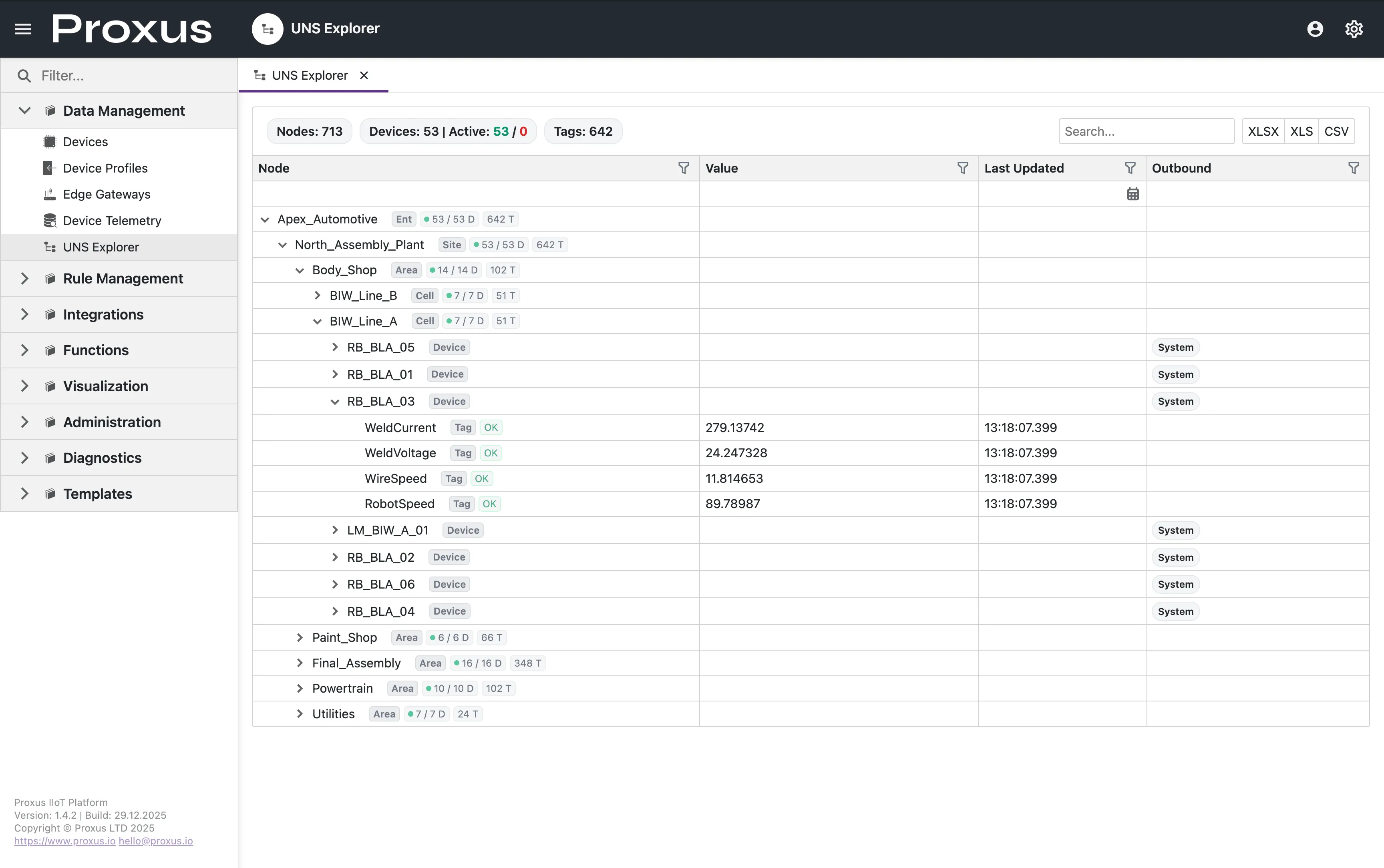
Recommended Structure
The standard hierarchy follows this pattern:
Enterprise / Site / Area / Line / Cell / [Metric]
Example Breakdown
| Level | Description | Example |
|---|---|---|
| Enterprise | The name of your company. | AcmeCorp |
| Site | Geographic location or factory name. | Istanbul_HQ |
| Area | A physical section of the plant. | Press_Shop |
| Line | A specific production line. | Line_04 |
| Cell | A machine or workstation. | Robot_Arm_B |
Naming Conventions
To ensure compatibility with MQTT brokers and other systems (Kafka, SparkplugB), follow these rules:
- No Spaces: Use underscores (
_) or CamelCase.- ❌
Line 01 - ✅
Line_01
- ❌
- Avoid Special Characters: Do not use
+,#,/, or$in names, as these are MQTT wildcard/system characters. - Be Descriptive:
- ❌
Temp(Ambiguous) - ✅
Hydraulic_Oil_Temp_C(Clear)
- ❌
SparkplugB Compatibility
If you intend to use the SparkplugB outbound connector, your UNS structure must map to the Sparkplug Group/Node/Device model:
- Group ID: Maps to
Enterprise/Site/Area - Edge Node ID: Maps to
Line - Device ID: Maps to
Cell
warning
Planning Ahead
Changing the UNS hierarchy after deployment can be difficult because downstream systems (Dashboards, Scripts) rely on the topic paths. Spend time designing your tree before adding hundreds of devices.