
Dec 16, 2025 · 7 min read
Methodology notes
What is an IIoT Platform? The 5 Core Pillars Explained
What an IIoT platform does, how it differs from an industrial data platform, and which edge, governance, storage, and integration capabilities to evaluate.
- Evidence level: Medium (field observations + public standards; not a universal benchmark).
- Measurement scope: Performance and economic outcomes vary by hardware, topology, workload shape, sampling profile, and process constraints.
- Primary references: IEC 62443-2-1, ISA-95 / IEC 62264, NIST SP 800-82r3.
- Implementation docs: Edge Architecture and Unified Namespace.
Application vs. Platform
When evaluating Industry 4.0 solutions, manufacturers often encounter products focused primarily on data visualization. While these dashboards provide significant value, it is important to distinguish between an IIoT "application" and an IIoT "platform" during architectural planning.
A software solution that visualizes a defined sensor set can be a useful IIoT application. An IIoT platform usually adds reusable connectivity, device or gateway operations, data processing, and application delivery. An industrial data platform extends that discussion to shared operational context, governance, historical retention, and controlled delivery across OT and IT consumers.
A dashboard that shows vibration data is an application. A system that manages thousands of devices, automatically collects vibration data, routes it through a rule engine, persists it, and lets other applications subscribe to it-that's a platform. The difference is architectural depth, not visual polish.
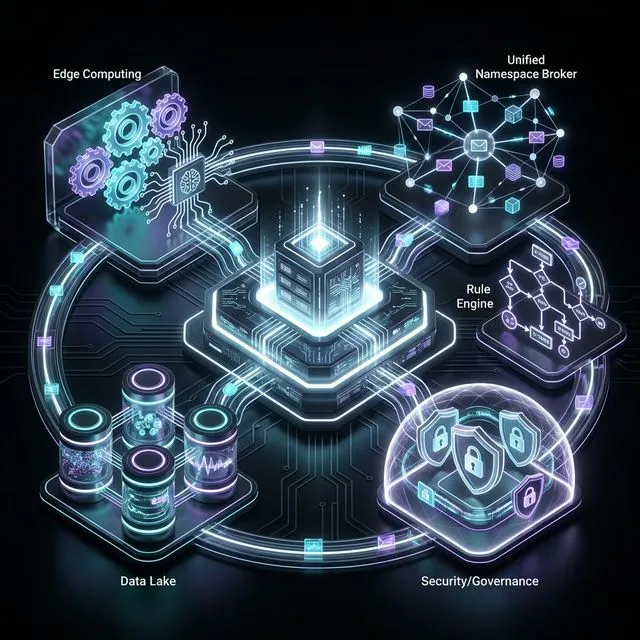
When evaluating vendors, use the five areas below as questions rather than a universal certification checklist. The required depth depends on source diversity, site count, operational ownership, security zones, consumer systems, and deployment model.
Outcomes depend on workload profile, hardware capacity, and deployment topology.
Why Your Factory Data Must Stay at the Edge
Not every workload should be moved to the cloud or a central site. Placement depends on latency, bandwidth, outage tolerance, data classification, retention, and operating ownership.
A true IIoT platform typically should include a robust Edge Computing layer. This should go beyond being a simple protocol converter that translates Modbus to MQTT. The platform typically should allow you to manage thousands of Edge Gateways worldwide from a central cloud interface.
You typically should be able to deploy new protocol drivers, update firmware, and change data collection frequencies on a gateway located in a factory across the world-all without sending a technician to plug in a laptop. Crucially, the Edge layer typically should support Store and Forward to improve data-loss risk minimization during network outages.
A shared operational model: Unified Namespace
SAP ERP
Predictive AI
Proxus Broker
MQTT Data Hub
Assembly Line 1
Packaging Line
In a legacy factory, systems communicate point-to-point (Spaghetti Architecture). The Quality Database talks directly to the PLC, and the ERP talks to the SCADA.
A Unified Namespace can reduce repeated point-to-point mappings by exposing governed operational topics and models to authorized consumers. The MQTT broker provides transport; topic ownership, schema, identity, quality, authorization, and lifecycle governance make the namespace usable.
The platform typically should provide the tools to normalize raw PLC tags (like DB4.DBX2.1) into clean, contextualized asset models (like FactoryA/PressLine1/Temperature). If a platform relies solely on hardcoded point-to-point API scripts to move data, it may lack the standard data modeling capabilities expected of an enterprise foundation.
From Raw Data to Instant Action: The Rule Engine
Data is useless without action. What happens when the vibration sensor on your critical motor exceeds the safe threshold?
A platform may provide a rule engine for alarms, event enrichment, notifications, calculations, and governed workflows. Any writeback requires a separate command model, authorization, validation, audit, timeout, and safety assessment. Emergency stops and deterministic interlocks remain in PLC and safety systems.
Storing the Flood: Time-Series Data Lake
Relational databases (SQL) are fantastic for managing employee payrolls, but they can quickly create bottlenecks when you hit them with high-frequency sensor readings.
An IIoT Platform typically should have a deeply integrated Time-Series Database (TSDB) optimized for ingesting massive "data storms". This Data Lake typically should allow the instant retrieval of historical data for AI training, reporting, and anomaly detection. Furthermore, it should handle data retention policies automatically (e.g., keeping raw millisecond data for 30 days, but only keeping 15-minute averages for 5 years to save disk space).
Defense in depth and explicit trust boundaries
The moment you connect an operational PLC to an IT network, you invite high-impact risk. A platform is only as good as its security model.
Enterprise IIoT Platforms enforce security at every layer:
- Outbound-Only Bridges: The Edge Gateway should avoid requiring inbound firewall ports in high-security deployments. It typically should push data out to the platform.
- Role-Based Access Control (RBAC): Can you securely restrict the newly hired intern so they can only view the dashboards for Line 1, without giving them the ability to change the temperature setpoints on Line 2?
- Audit Trails: Every single action-whether changing a rule, acknowledging an alarm, or an AI model running an MCP query-typically should be permanently logged for compliance purposes.
Where Does Proxus Fit In?
Proxus is positioned as an Industrial Data Platform for OT and IT operations. IIoT connectivity is one part of that platform, alongside operational modeling, edge processing, storage, dashboards, rules, and governed delivery to enterprise consumers.
When this may not be suitable
- Lower-frequency telemetry may not justify full distributed complexity.
- Small single-line plants may prefer simpler architectures first.
- Strict legacy constraints may require phased adoption.
- Safety-critical closed-loop control should remain in PLC/Safety PLC layers.
Results vary with workload, hardware, and topology.
Frequently Asked Questions
How is an IIoT Platform different from SCADA?
SCADA systems are designed for real-time visualization and control of a specific process. An IIoT Platform is a broader data infrastructure layer that includes Edge orchestration, a Unified Namespace, rule engines, data lake persistence, and enterprise integrations. SCADA can become a consumer of the IIoT Platform. See SCADA vs UNS for the full comparison.
Can an IIoT Platform replace my existing MES?
Not typically. An IIoT Platform complements MES by providing the real-time data infrastructure that MES lacks. It feeds clean, contextualized data into MES systems, replacing the fragile point-to-point integrations MES traditionally relies on.
What protocol support should I expect from an IIoT Platform?
Start from the protocols and device behaviors actually present in the target sites. Validate driver scope, polling and subscription behavior, datatype coverage, quality handling, security, and edition/version availability. See Proxus Connectivity for the published product scope.
References
- IEC 62264 (ISA-95) - Enterprise-control system integration, defining the functional layers that an IIoT Platform spans.
- MQTT v5.0 OASIS Standard - The publish-subscribe protocol that serves as the UNS transport layer. mqtt.org
- Anthropic, "Model Context Protocol" - Open specification for securely connecting AI models to external data sources, relevant to Pillar 5 (Security). MCP Spec